CNC turning is a machining process in which a computer-controlled tool removes material from a rotating workpiece, producing repeatable, precise parts in the form of solids of revolution: shafts, bushings, discs and threaded components. It suits round and axially symmetric parts, while milling is better for flat walls and complex geometry. Below we explain how the process works, which operations and lathes are used, what drives quality and cost, and how to prepare an enquiry.
Table of contents
- What CNC turning is
- How the CNC turning process works, step by step
- Which operations are performed on a lathe
- Types of lathes
- Machining parameters and factors affecting quality
- Which materials can be turned
- When to use CNC turning and when milling
- Applications of CNC turning
- CNC turning services at Sacher
- CNC turning - FAQ
What CNC turning is
In CNC turning, the workpiece is clamped in the lathe chuck and rotates around its axis. The cutting tool, most often a turning insert mounted in a turret, moves along and across the workpiece and removes successive layers of material as chips. The tool path is programmed, so the lathe repeats it identically on every part.
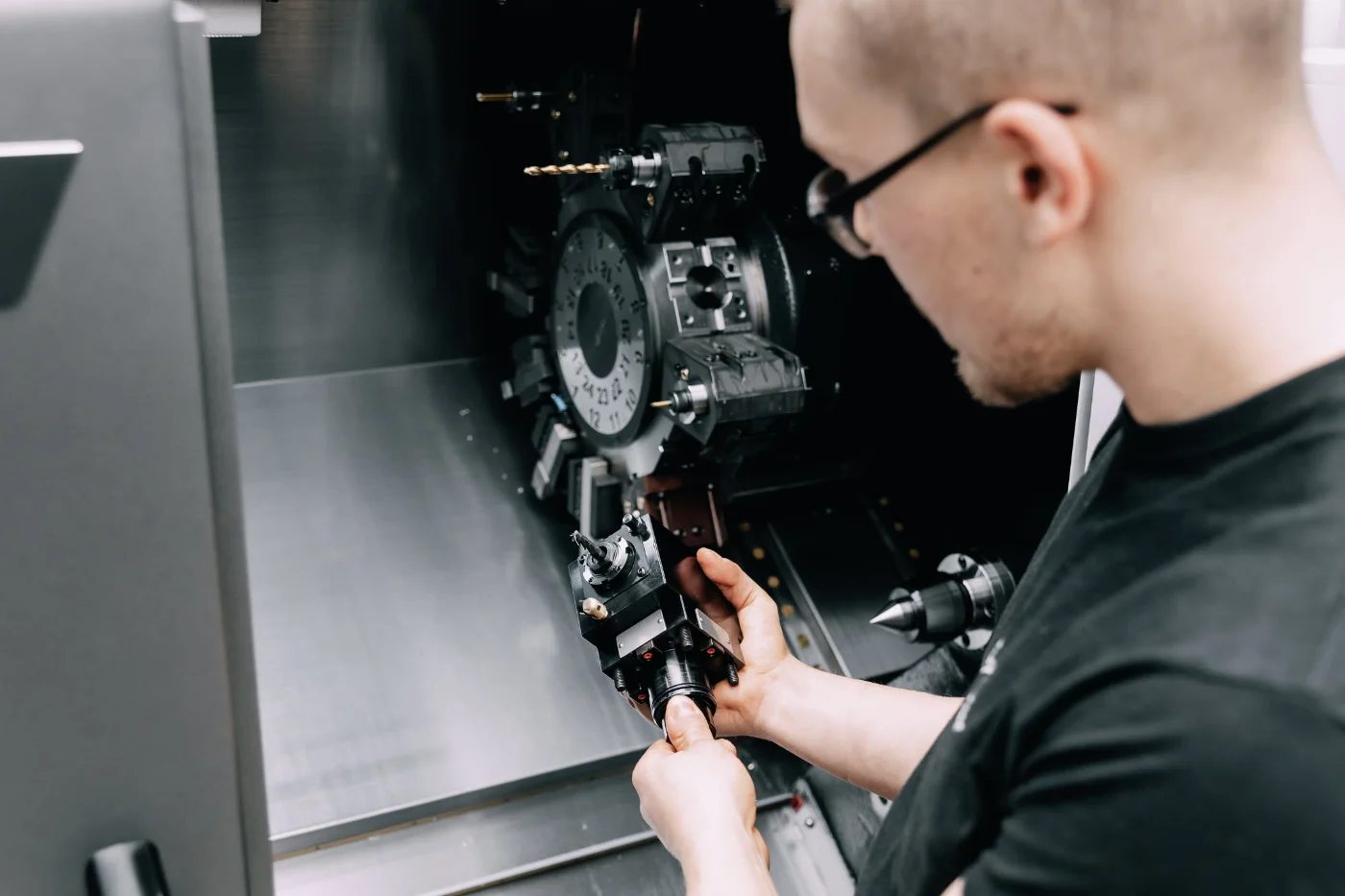
CNC stands for computerized numerical control. Computer-controlled machines read a program that defines the spindle speed, feed, depth of cut and the path of the cutting tool. CNC technology replaced manual machine setup and keeps dimensions constant across the whole batch.
The result of the process is an axially symmetric part: cylindrical, conical and face surfaces, grooves and threads. The rotation of the workpiece is the main cutting motion, and the movement of the turning tool is the feed motion.
How the CNC turning process works, step by step
The production process on a CNC lathe consists of several stages:
- Documentation and program. Based on a technical drawing or a 3D model, the technologist prepares a program that defines the sequence of operations, the tools and the cutting parameters, taking into account tolerances and the required roughness.
- Clamping the material. A bar or forging is held in a jaw chuck or a collet. Longer parts are additionally supported with a tailstock centre so that they do not deflect during machining.
- Tool setup. The operator enters the tool lengths and radii into the control and sets the part zero point.
- Roughing. With a large depth of cut, the machine quickly removes most of the excess material.
- Finishing. A small depth of cut and gentler parameters determine dimensional accuracy and surface quality. Tool changes take place automatically in the turret.
- Additional operations. The same machine can perform drilling, threading, grooving and parting off the finished part.
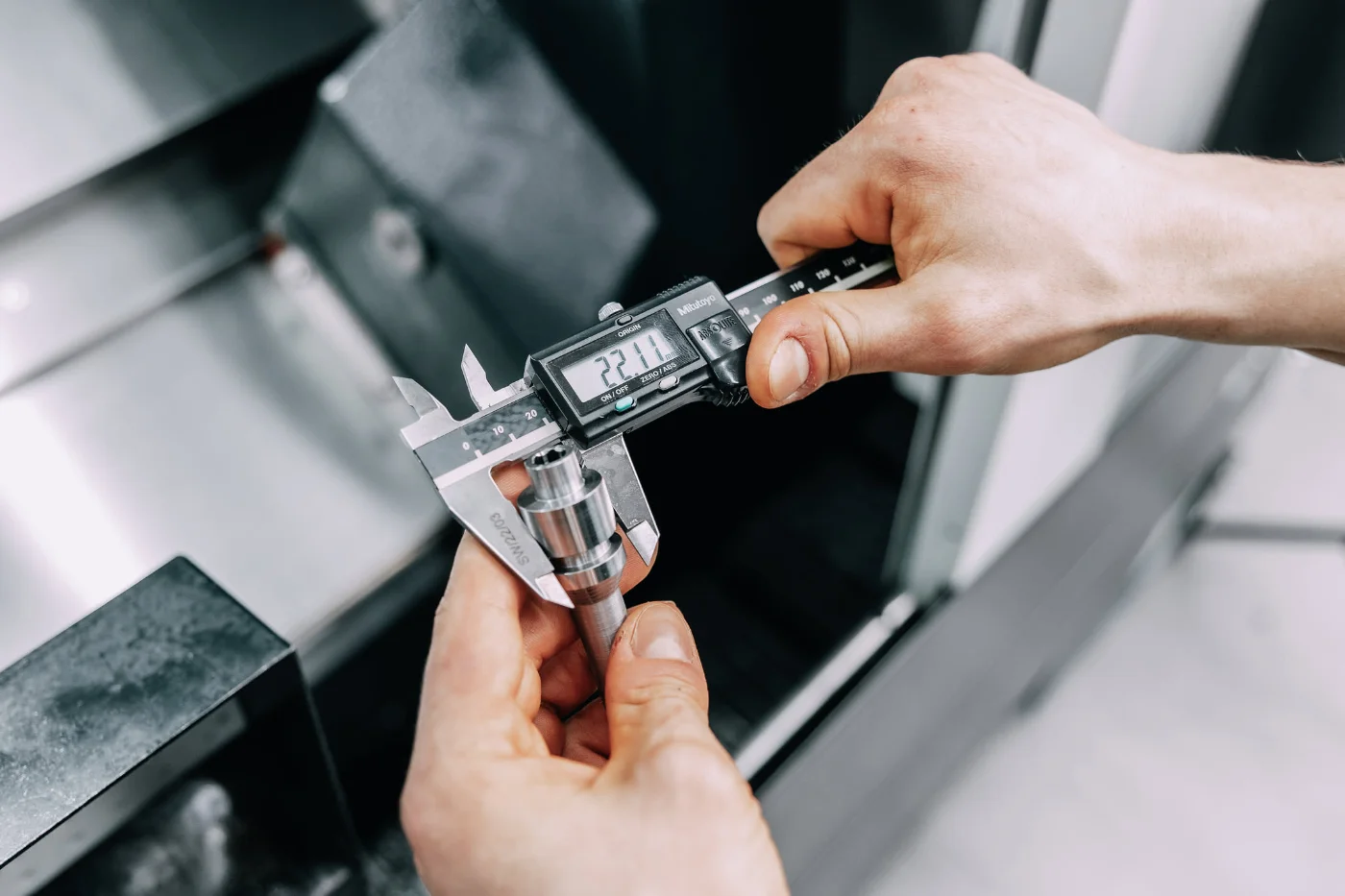
- Inspection. Critical dimensions are measured with a caliper, a micrometer or on a measuring machine and compared with the drawing.
Thanks to the precision of numerical control, the process is repeatable. When changing batches, it is enough to load a new program and change the tools.
Which operations are performed on a lathe
The versatility of CNC turning comes from the fact that one machine performs many operations and the tool path can be freely programmed. When removing material from different surfaces, the following are used above all:
| Operation | What it involves | Typical example |
|---|---|---|
| Longitudinal turning | The tool moves parallel to the axis and reduces the diameter | Shafts, journals |
| Facing | The tool moves perpendicular to the axis and machines the face | Shaft ends, flanges |
| Boring | Machining a hole from the inside | Bushings, bearing seats |
| Grooving | Cutting grooves on the outer or inner surface | Grooves for retaining rings |
| Threading | Cutting external and internal threads | Screws, fittings |
| Drilling | Making an axial hole | Bushings, discs |
| Parting off | Separating the finished part from the bar | Series production from bar stock |
As a result, a lathe can produce parts of various shapes and diameters, from small pins to large discs. There is no need to change machines to make threads, holes and grooves.
Types of lathes
Lathes come in different types, and the choice of machine depends on the part size, the batch size and the required accuracy. Four solutions are the most common:
- Manual lathes. They are operated by an operator who sets the feed and depth of cut by hand. They are suited to single parts, repairs and simple tasks.
- Horizontal CNC lathes. This is the standard machine for producing parts in the form of solids of revolution. A rigid bed with guideways and a control program keep accuracy high across the whole batch.
- Vertical lathes. The workpiece rotates around a vertical axis on a horizontal table. This makes it easier to clamp large and heavy parts with a large diameter, such as wheels, discs and housings.
- Automatic lathes. A machine designed for series production of small parts from bar, such as screws and pins. The bar is fed automatically and the cycle time is very short.
Turn-mill centres with driven tools are also increasingly popular, combining turning with CNC milling in a single setup. They have a tool magazine, so tool changes take place without operator involvement.
Machining parameters and factors affecting quality
Three basic parameters determine the result of turning. Cutting speed defines how fast the tool edge moves relative to the material. Feed is the tool travel per revolution, and depth of cut is the thickness of the layer removed in one pass.
| Parameter | What happens when it is increased | What to watch out for |
|---|---|---|
| Cutting speed | Shorter machining time, often better surface quality when chosen correctly | Edge overheating and shorter tool life |
| Feed | Shorter machining time | Higher roughness and higher cutting forces |
| Depth of cut | More material removed in one pass | Higher cutting forces, vibration and workpiece deflection |
The factors that influence the choice of parameters are:
- Type of material. Harder steels require a lower cutting speed, while aluminium can be machined much faster.
- Geometry and rigidity of the workpiece. Long, slender shafts deflect under cutting force, so they require support and gentler parameters.
- Cutting tool. The insert grade, its coating and the edge geometry all matter.
- Cooling. Coolant carries away heat and chips, and thereby extends tool life.
- Required surface quality and tolerances. The more accurate the part, the more finishing passes and the longer the machining time.
Optimising the parameters means finding a compromise between machining time, tool life and surface quality. This is one of the reasons why an experienced technologist affects the cost and the lead time.
Which materials can be turned
CNC turning is suitable for machining metals and plastics. The type of material affects the choice of tools, parameters and cooling, as well as the machining cost.
| Material | Characteristics when turning | Typical parts |
|---|---|---|
| Structural and alloy steel | Good machinability, possibility of later heat treatment | Shafts, gears, pins |
| Stainless steel | Corrosion resistant, but harder to machine because it conducts heat poorly and work-hardens during cutting. Requires sharp tools and cooling | Parts for the food, medical and chemical industries |
| Aluminium | Light and easy to machine, allows high cutting speeds. Requires sharp tools because of its softness | Housings, bushings, lightweight structural parts |
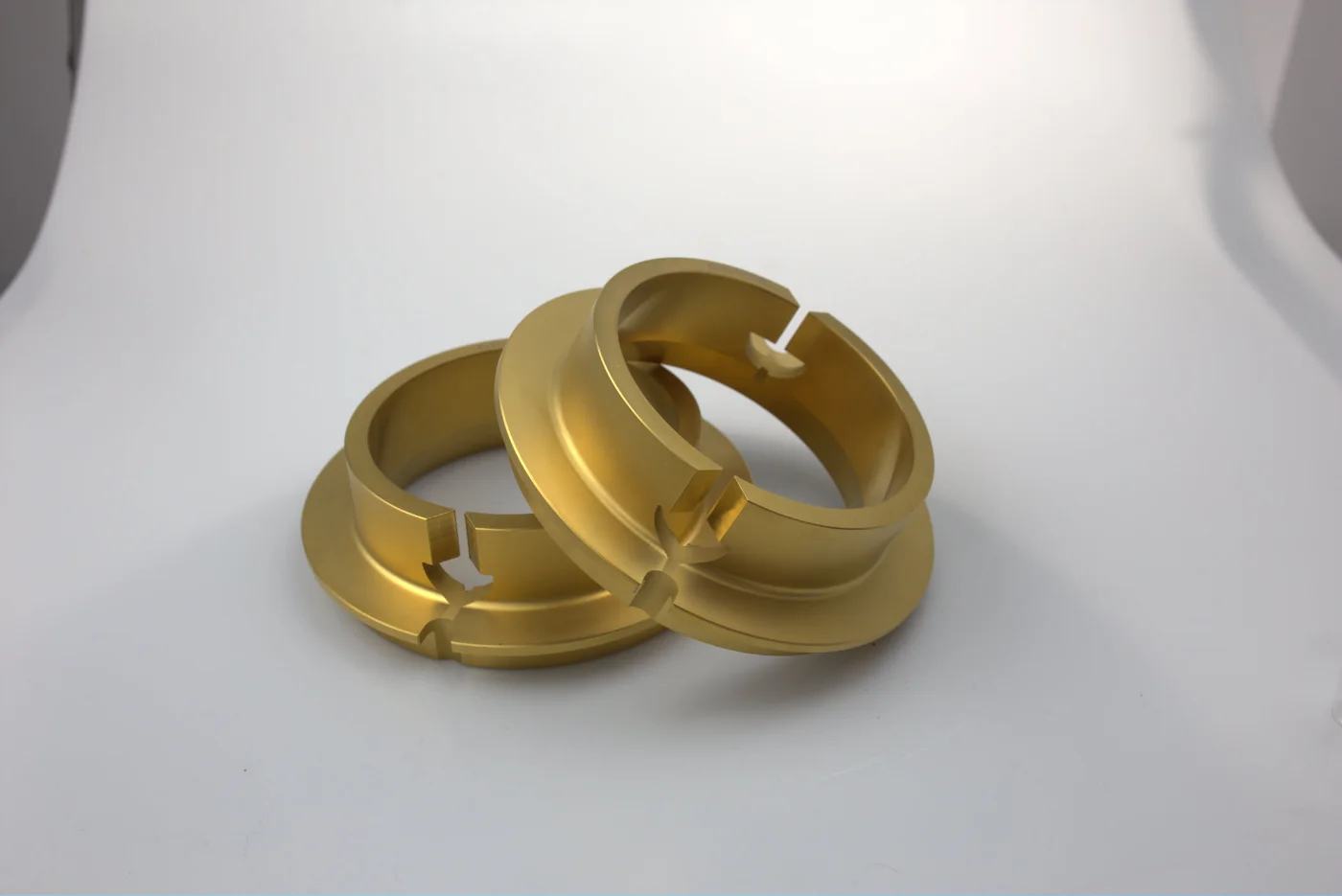
| Brass and bronze | Very good machinability, brittle chips | Fittings, plain bearings, valves |
| Plastics | Low cutting forces, but risk of deformation due to heat and the elasticity of the material | Bushings, rollers, insulating parts |
With stainless steel and plastics, knowledge of the material is especially important. The same drawing made from a different type of material may require different tools and a different machining time.
When to use CNC turning and when milling
CNC turning is worth choosing when the part is round or axially symmetric, that is, shaped like a shaft, bushing, disc or ring. In such cases turning is usually faster and cheaper than milling, and it also provides very good concentricity of the surfaces.
CNC milling is better when the part has flat walls, pockets, off-axis holes or complex geometry. Milling also works well for parts with complicated shapes that cannot be obtained by rotating the workpiece. The comparison below shows the main differences:
| Criterion | CNC turning | CNC milling |
|---|---|---|
| Main motion | The workpiece rotates, the tool moves | The tool rotates, the workpiece is fixed |
| Typical shape | Shafts, bushings, discs, threaded parts | Plates, bodies, housings, moulds |
| Complex geometry | Limited to axially symmetric shapes | Possible, especially on 5-axis machines |
| Series production | Very efficient, especially from bar | Efficient with suitable tooling |
| Concentricity of surfaces | Very good, because the part is machined in one setup around one axis | Requires careful setup |
Often the best solution is to combine both technologies. A part can be turned first, and then planes or holes can be milled into it, in separate operations or on a turn-mill centre. The choice is best made by a technologist based on the drawing.
Applications of CNC turning
CNC turning is a basic production process in many branches of industry. It is most often used by:
- Automotive industry: shafts, bushings, hubs, and parts of drive systems, valves and injectors.
- Aerospace industry: structural parts, connectors and bushings made of aluminium and steel, produced with high precision and documented quality control.
- Medical industry: components of medical tools and devices, often made of stainless steel.
- Machine building and automation: shafts, guides, bushings, cylinder parts and gear blanks that are later milled or ground.
- Hydraulics and pneumatics: fittings, spindles and valve components.
Turning is used both for single prototypes and for the production of small, medium and large batches. This technology makes it possible to produce parts with repeatable dimensions, which matters in every industry where components have to fit together. This applies especially to the automotive industry, where parts are produced in large batches.
CNC turning services at Sacher
Sacher has been developing its competence in producing precision parts since 1989. As a result, we have extensive experience, and thanks to a modern machine park (28 machining centres) and a team of 52 specialists we are able to offer CNC turning services for metals and plastics. We make prototypes, single parts and small and medium batches.
We also offer additional services in one place: milling, grinding, EDM, our own heat treatment and quality control. This shortens the lead time, because the part does not have to travel between several plants, and one contractor is responsible for the result.
To prepare a quote, please send us:
- a technical drawing or 3D model,
- the material grade,
- the quantity and the expected deadline,
- dimensional tolerances and the required surface roughness,
- additional requirements, e.g. heat treatment or measurement inspection.
CNC turning - FAQ
How does CNC turning differ from turning on a manual lathe?
CNC turning differs from turning on a manual lathe in that the program, not the operator, sets the feed and depth of cut. As a result, every part is made the same way, and the machine can work faster and produce more complex shapes.
What accuracy can be achieved?
The accuracy of CNC turning depends on the machine, the material and the shape of the part. CNC lathes usually achieve tolerances in the range of hundredths of a millimetre, and tighter ones for special requirements. We agree the specific values after analysing the drawing.
Can a thread be made on a lathe?
Yes, an external or internal thread can be made on a lathe. Threading is one of the basic operations, performed on the same machine as turning.
Can stainless steel, aluminium and plastics be turned?
Yes, stainless steel, aluminium and plastics can be turned. However, each of these materials requires different tools and cutting parameters, and stainless steel and plastics need particular attention.
From what quantity is CNC turning worthwhile?
CNC turning is worthwhile both for single prototypes and in series. The program and setup are prepared once, so with a larger quantity the cost of a single part falls.