5-axis machining pays off above all when a part has complex geometry and needs machining from many sides, such as prototypes, precision parts, medical components or die and punch elements. For simple parts, 3 axes are entirely enough. Below we explain the difference between 5-axis and 3-axis machining, what simultaneous machining is and when the premium for 5 axes brings real savings.
Table of contents
- How 5-axis machining works
- Simultaneous machining (5 axes at once)
- When 5-axis machining pays off
- Which parts are worth making on 5 axes
- When 3 axes are enough
- 5 axes at Sacher
- Summary
How 5-axis machining works
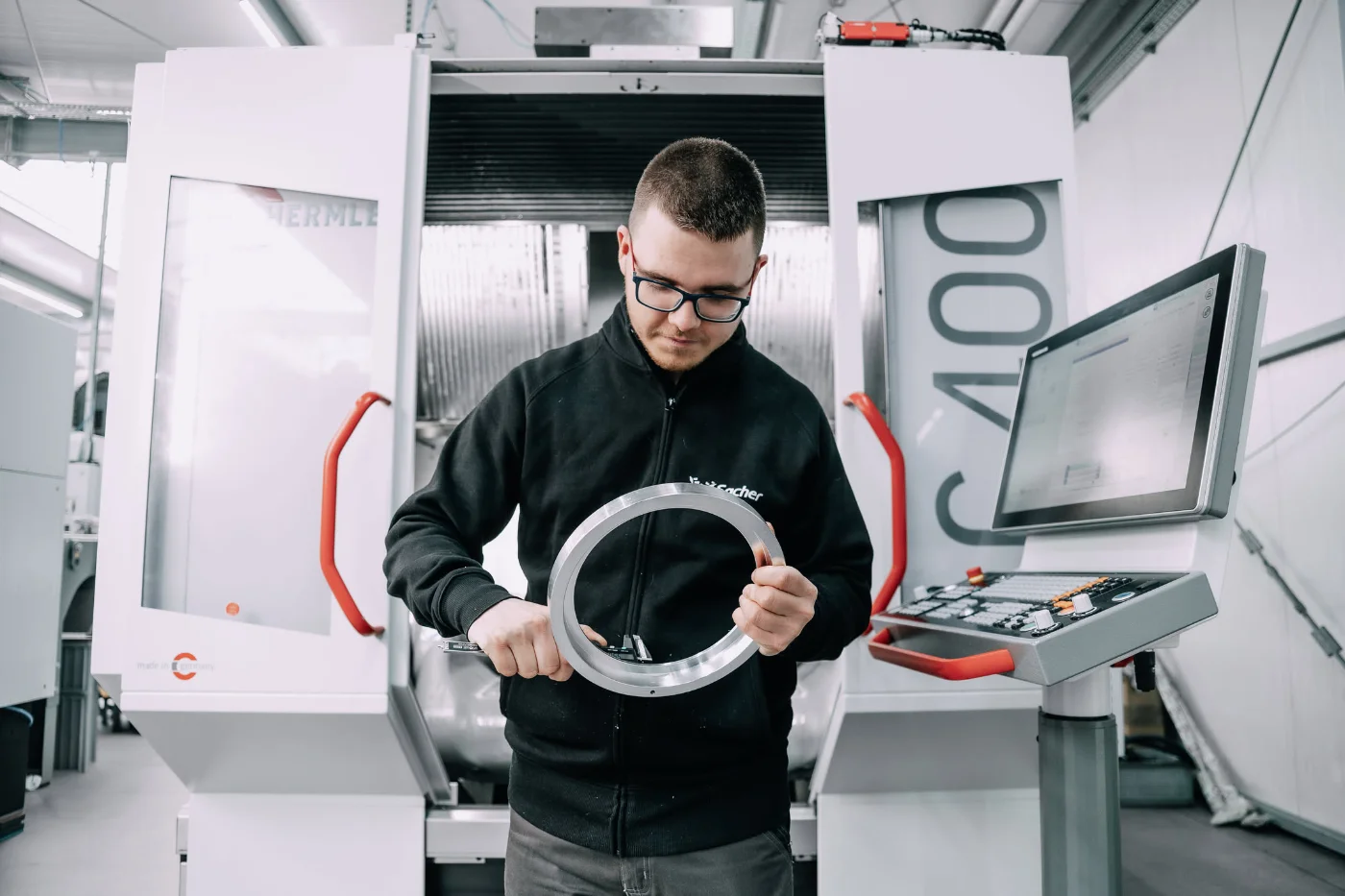
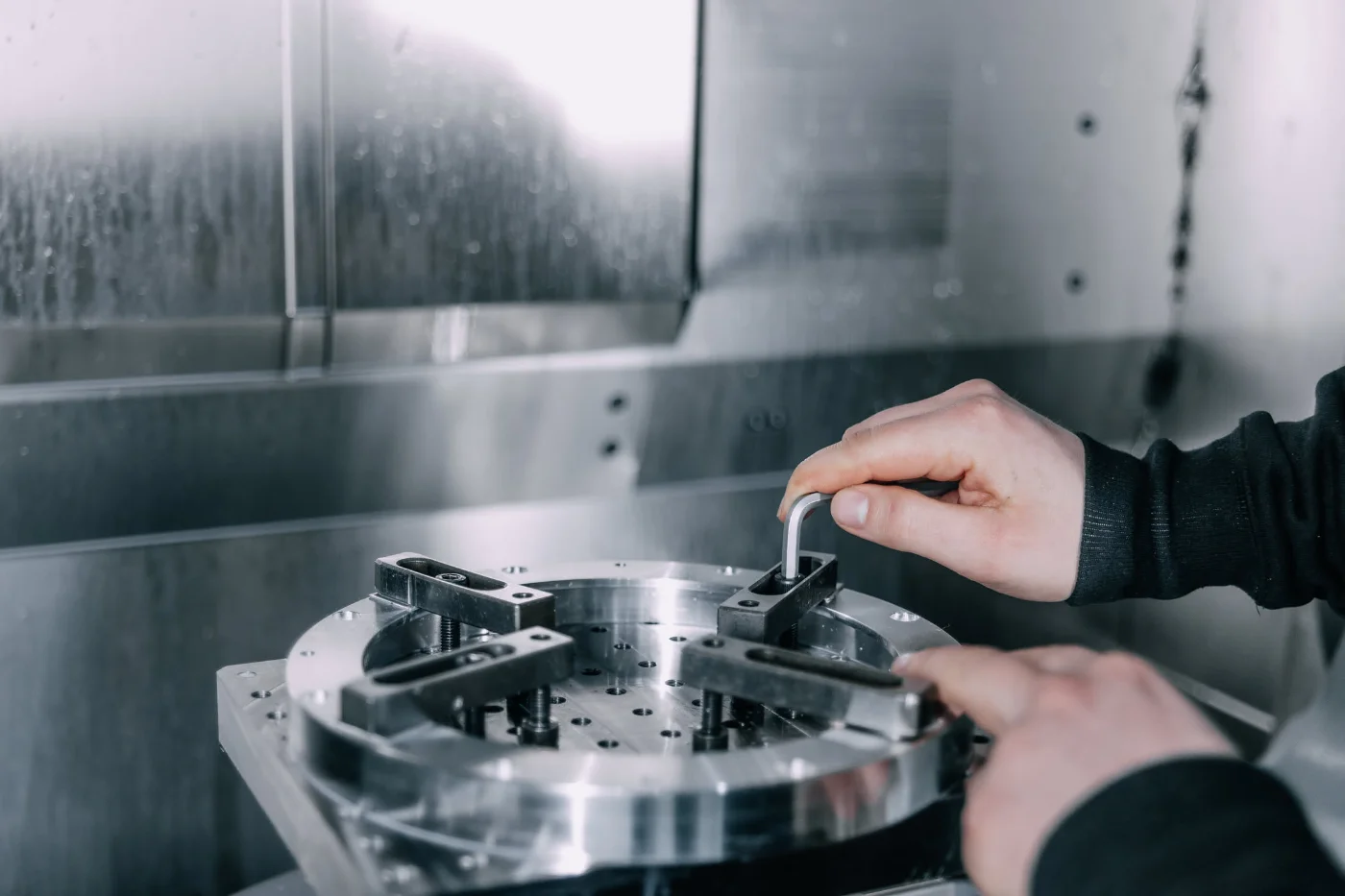
5-axis machining means milling on a machining center that has two rotary axes in addition to the three linear axes (X, Y, Z). This lets the tool approach the part from any angle, without unclamping and re-fixturing it.
There are two ways of working:
- Positional machining (3+2): the machine positions the part, locks the rotary axes and mills as on 3 axes. It works well for parts with many faces and holes at different angles.
- Simultaneous machining (5 axes at once): all five axes move at the same time. It is needed for free-form surfaces such as blades, impellers and complex molds.
In 3-axis machining, every new side of the part means another setup. On 5 axes, many surfaces are produced in a single setup.
Simultaneous machining (5 axes at once)
Simultaneous machining means that all five axes move at the same time during cutting, and the tool follows the part surface smoothly. In positional machining (3+2) the rotary axes only position the part, whereas in simultaneous machining they work while the cut is being made.
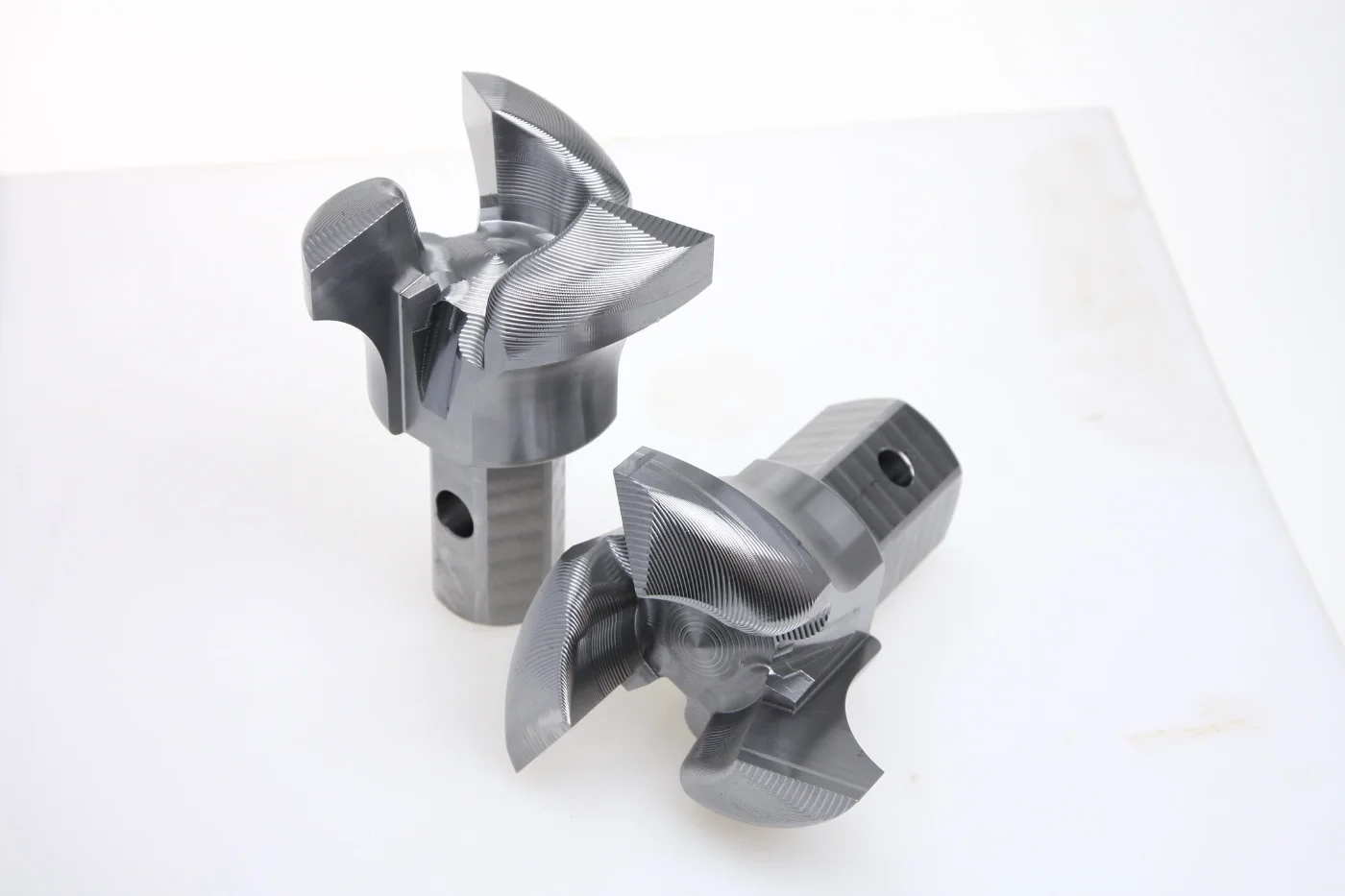
This way of working is needed for free-form surfaces, meaning surfaces that cannot be described with simple planes and cylinders. Typical examples are blades, impellers, medical parts with organic shapes, and complex molds.
Simultaneous machining offers several benefits:
- Better surface quality. The tool keeps an optimal angle to the machined surface, so tool marks are smaller and finishing often needs less manual work.
- Shorter tools and less vibration. Tilting the part or the head allows a shorter cutter and access to hard-to-reach areas.
- More efficient cutting. Constant contact between tool and material and smooth motion make better use of the cutting edge.
This method does place higher demands on the process. It requires advanced CAM software, a properly configured postprocessor and a simulation of the whole process with collision checking, because moving five axes at once increases the risk of a collision between tool, holder and part. Programming and preparation therefore take longer than with 3+2, which should be factored into the cost assessment.
When 5-axis machining pays off
The hourly rate of a 5-axis machine is usually higher than that of a 3-axis machine, but the final cost is decided by total time and quality of the result, not by the hourly rate alone. 5-axis machining most often pays off for four reasons:
- Fewer setups. Every re-clamping costs setup time and risks datum errors. Machining several sides in one setup reduces both problems.
- Higher accuracy of the relative position of features. When holes and surfaces are produced in one setup, their relative position depends on the machine rather than on several separate clampings.
- Shorter lead time. Fewer operations and changeovers mean a faster finished part, which matters especially for prototypes and urgent orders.
- Better tool access. Tilting the part allows a shorter tool, which reduces vibration and improves surface quality. It also reaches areas that cannot be accessed from one side.
Fixturing is another factor. One universal clamping instead of several dedicated fixtures can be cheap, especially for single parts and small batches.
Which parts are worth making on 5 axes
Parts with features on several sides or with irregular surfaces benefit the most:
| Type of part | Why 5 axes |
|---|---|
| Prototypes | Fast turnaround without preparing many fixtures, easy to implement changes |
| Medical components | Complex shapes, high demands on surface finish and repeatability |
| Stamping and forming dies | Forming surfaces, recesses and angled walls |
| Precision parts | Relative position of features preserved thanks to machining in one setup |
| Industrial equipment parts | Housings and enclosures with holes and faces at different angles |
A good sign that 5 axes are worth considering is a drawing where the part would have to be turned over three or more times, or one with undercuts and deep pockets that are hard to reach from above.
When 3 axes are enough
5-axis machining is not the answer for every part. Three axes are usually the better choice when:
- the part is simple and needs machining mainly from one or two sides,
- the shape is a plate, a housing with holes perpendicular to its faces, or a flat part with pockets,
- the batch is large and fixtures prepared for 3 axes allow many parts to be made quickly and cheaply.
For such parts the extra cost of 5 axes brings no benefit. That is why, when requesting a quote, it is worth showing the drawing to a technologist who will choose the cheapest method that meets the requirements instead of assuming 5 axes from the start.
5 axes at Sacher
Since 1989 we have been developing our expertise in the production of precision parts. Today we have 52 specialists and a machine park of 28 machining centers. We complement machining with EDM, grinding, quality control and our own heat treatment, so we carry out many stages in one place.
We are developing our machine park toward 5-axis machining and automation, among other things through the investment in a HERMLE C 400 with the HS flex heavy pallet system. The pallet system lets us prepare the next jobs while the machine is running the current one, which increases the machining center's productive time. We write more about this in our article on CNC machining automation.
We make prototypes, single parts, and small and medium batches for demanding industrial applications.
Summary
5-axis machining pays off for complex parts with features on several sides, and whenever accuracy of relative position and a short lead time matter. For simple parts and large batches, 3 axes are often the better choice.
Not sure which method is better in your case? Send us a drawing or a 3D model together with the material, quantity and required tolerances. Our technologists will select the most cost-effective technology and prepare a quote.