Plasma nitriding is a thermochemical treatment in which nitrogen is introduced into the steel surface by a glow discharge in a vacuum, creating a hard layer resistant to wear and fatigue while the core of the part stays ductile. The method is chosen where dimensional accuracy, low distortion and the ability to harden only selected areas matter, for example for gears, shafts, dies and injection mould tooling. Below we explain how the process works, how it differs from gas and salt-bath nitriding, and which parts and materials it suits.
Table of contents
- How plasma nitriding works
- How the process runs step by step
- Plasma nitriding versus gas and salt-bath nitriding
- Advantages of plasma nitriding
- Limitations and drawbacks
- Applications and materials
- Plasma nitriding at Sacher
- Plasma nitriding - FAQ
How plasma nitriding works
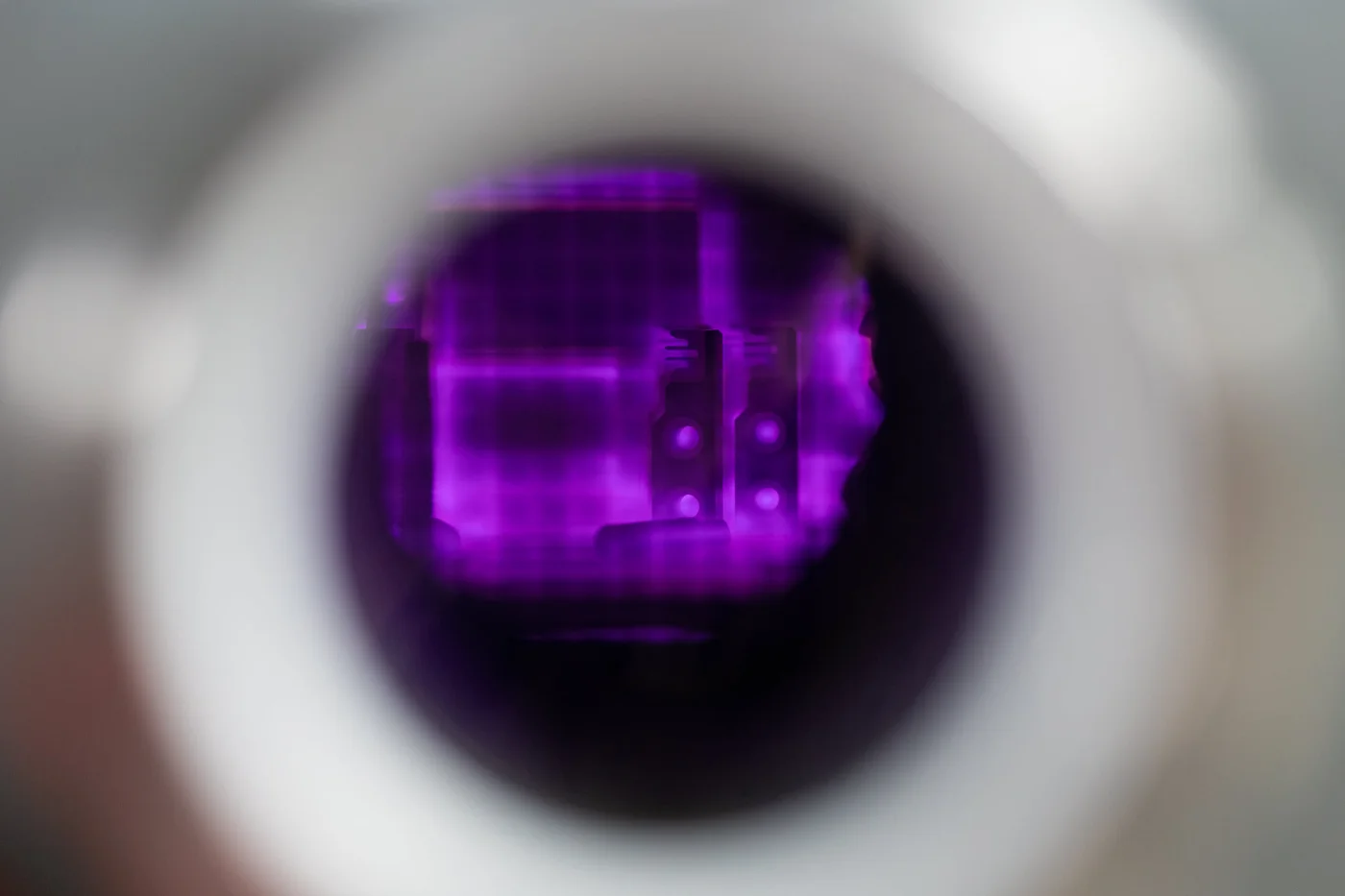
The process takes place in a sealed vacuum furnace at low pressure, in an atmosphere of nitrogen and hydrogen. A high voltage is applied between the load and the furnace wall. The part acts as the cathode and the furnace wall as the anode. The gas is ionized and plasma forms, a glowing discharge around the part.
Nitrogen ions accelerate in the electric field and strike the surface of the part. The impacts clean it of contaminants and thin oxide films, heat the load, and let nitrogen diffuse into the material. In steel, nitrogen forms hard nitrides with iron and alloying elements.
The result is a nitrided layer made up of two zones: a thin compound layer at the surface and, beneath it, a diffusion zone in which nitrogen is dissolved in the steel or forms fine nitride precipitates. The gas composition and discharge parameters make it possible to tailor the thickness and structure of this layer. For example, the compound layer can be limited or omitted when the part will work under heavy loads.
The process temperature is usually between about 350 and 580°C, far lower than in hardening. For quenched and tempered steels, the nitriding temperature is usually chosen below the tempering temperature, so the core of the part keeps its properties.
How the process runs step by step
- Preparing the parts. The surface must be clean and degreased, because contamination can cause unstable discharges. Areas that must stay soft are protected with mechanical shields.
- Loading and fixturing. The parts are arranged in the load so that all are properly connected electrically and heated evenly.
- Pumping down the furnace. After the chamber is closed, the pressure is lowered and a mixture of process gases, usually nitrogen and hydrogen, is introduced.
- Heating and ion cleaning. Once voltage is applied, plasma forms, cleans and activates the surface and heats the load to process temperature.
- Soaking. Nitrogen diffuses into the material. The time depends on the steel grade and the required case depth, and ranges from several to several dozen hours.
- Controlled cooling. The load cools in the furnace in a gas atmosphere and can be removed at low temperature. As a result, distortion is small.
- Quality control. After nitriding, surface hardness and part dimensions are checked, among other things.
Plasma nitriding versus gas and salt-bath nitriding
Plasma nitriding is one of the three most widely used methods. The comparison below shows the main differences. Values are indicative and depend on the steel grade and requirements.
| Feature | Plasma | Gas | Salt bath |
|---|---|---|---|
| Process environment | Nitrogen and hydrogen plasma in a vacuum | Ammonia in a controlled-atmosphere furnace | Molten salts containing nitrogen |
| Temperature | About 350–580°C, wide range | About 500°C and above | About 560–580°C |
| Process time | Usually the shortest of the gas-atmosphere methods | From over ten to several dozen hours | Usually several hours |
| Layer control | Very good, set by gas composition and discharge parameters | Limited | Limited |
| Masking | Mechanical shields | Requires special protective coatings | Difficult |
| Environmental impact | No ammonia or salts, low gas consumption | Ammonia in the process atmosphere | Salts require disposal |
| Equipment cost | High (vacuum system and power supplies) | Lower | Lower |
The main arguments for the plasma method are control of the layer structure, the ability to nitride at low temperature, and easy masking.
Advantages of plasma nitriding
- High hardness and wear resistance. The hard surface layer limits abrasion, galling and fatigue wear. In steels with chromium, molybdenum and vanadium, surface hardness can exceed 1000 HV.
- Minimal distortion. Low temperature and slow cooling in the furnace with no liquid quenching mean parts barely change dimensions. They can often be finish-machined before nitriding.
- Control of layer structure. Gas composition, temperature and discharge parameters make it possible to tailor the layer thickness and to limit or omit the brittle compound layer.
- Nitriding selected areas. Areas that must stay soft are shielded mechanically, without galvanic protective coatings.
- Uniformity on complex shapes. The plasma surrounds the part, so the process works well on complex geometry, including holes and grooves.
- Wide range of materials. Not only structural steels can be nitrided, but also tool steels, stainless steels, cast iron and sintered steels.
- Lower environmental burden. The process uses nitrogen and hydrogen instead of ammonia, and gas consumption is low.
Limitations and drawbacks
Plasma nitriding is not the answer for every part. Several limitations need to be considered:
- Surface cleanliness. Contamination can cause unstable arcing, so parts must be carefully prepared.
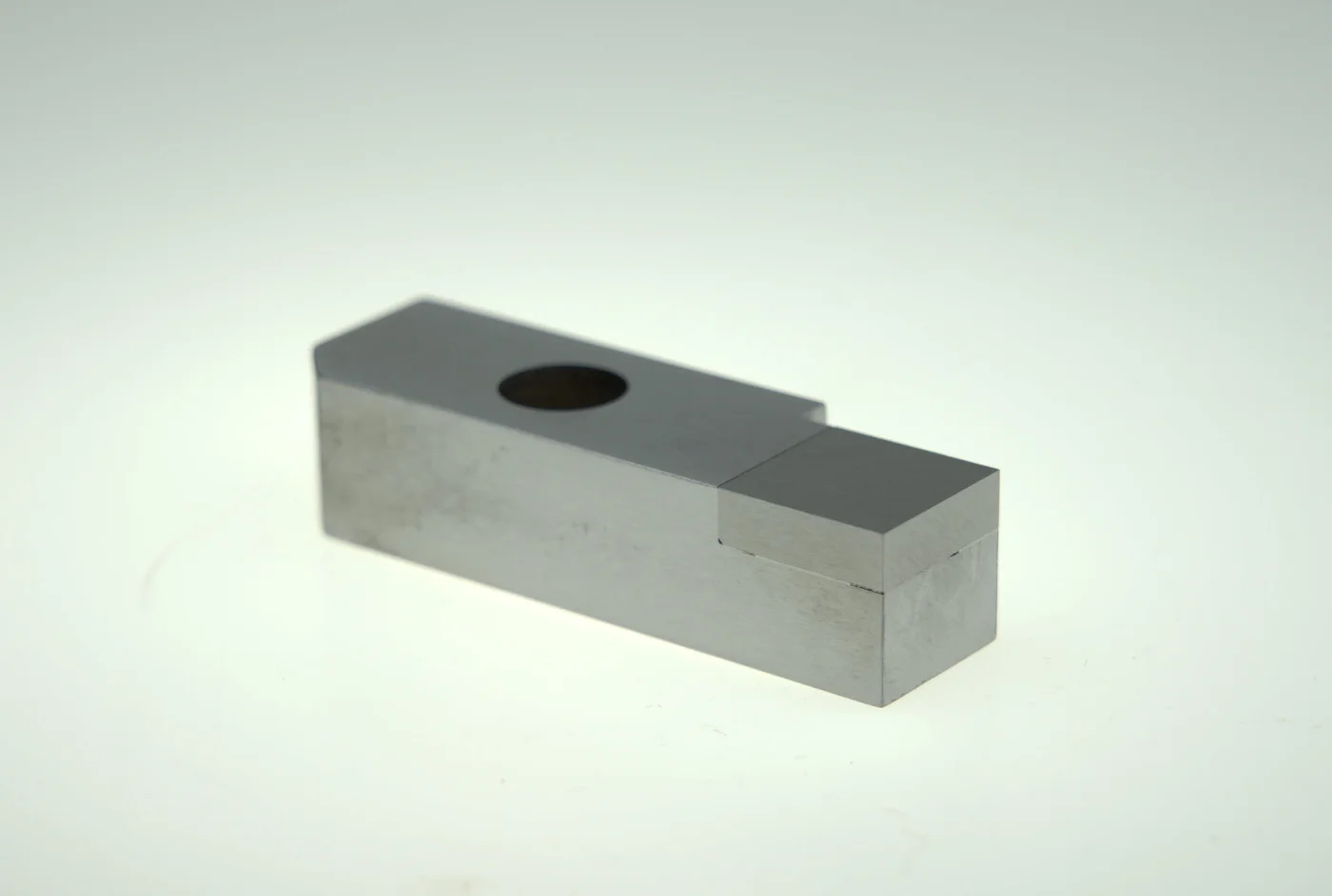
- Load arrangement. The amount of heat depends on the surface area of the part, so it is hard to combine very different shapes and sizes in one load. Parts must be arranged so that selected areas do not overheat.
- Material. The best results come from steels containing nitride-forming elements such as chromium, molybdenum and vanadium. In plain carbon steels the layer is thinner and less hard.
- Limited case depth. Nitriding produces a layer tens to hundreds of micrometers thick. Under very high surface pressures, another method may be needed.
- Cost. The vacuum installation is expensive, and profitability depends on batch size and furnace fill.
Applications and materials
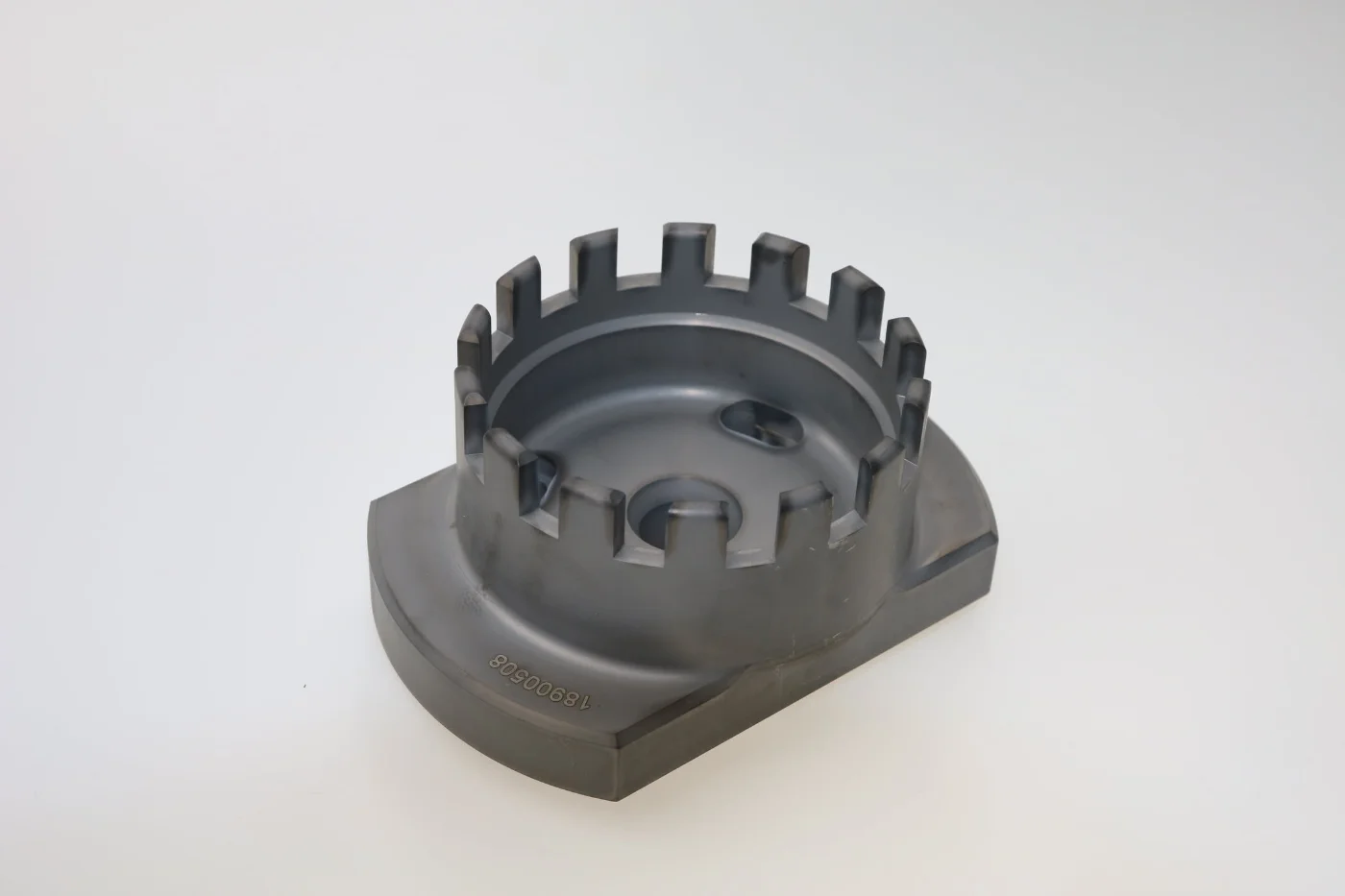
Plasma nitriding is used on parts that work under mechanical load and are exposed to abrasion, galling or material fatigue. Typical examples include:
- gears, shafts, axles and camshafts,
- valve and injector components,
- extruder screws and barrels,
- die-casting and plastic injection molds,
- forging dies and cold-forming tools.
Steels containing chromium, molybdenum, vanadium or aluminum are best suited to nitriding, as these elements form hard nitrides. The method is also used for tool steels, stainless steels, cast iron and sintered steels. For stainless steels, the parameters must be chosen so as to limit the loss of corrosion resistance.
A good candidate is a part that will be finish-machined before nitriding, since dimensional changes after the process are small.
Plasma nitriding at Sacher
We carry out plasma nitriding in-house, as part of Sacher's heat treatment. We combine it with machining, grinding, EDM and quality control, so the part goes through the whole process in one place. This shortens lead time, reduces transport between plants and gives you a single contractor responsible for the end result.
The typical sequence is rough machining, quenching and tempering, finish machining, nitriding and, if needed, surface finishing. We choose the process route to suit the material and the drawing requirements.
To prepare a quote, please send us:
- a drawing or 3D model of the part,
- the steel grade or material,
- the quantity and deadline,
- the required hardness and case depth, if specified,
- which surfaces must remain unnitrided.
Plasma nitriding - FAQ
Does plasma nitriding change the dimensions of a part?
Plasma nitriding changes the dimensions of a part only slightly and predictably. Because of the low temperatures and no liquid quenching, distortion is small, so parts are often nitrided after finish machining.
What hardness can be achieved?
The hardness depends on the steel grade and process parameters. In steels with chromium, molybdenum and vanadium, surface hardness can exceed 1000 HV. We confirm the specific value for a given material.
How does nitriding differ from carburizing?
Carburizing requires heating the steel to a high temperature and quenching, which usually causes greater distortion. Nitriding takes place at a lower temperature and needs no quenching after the process.
Can stainless steel be nitrided?
Yes, stainless steel can be nitrided. The plasma removes the thin passive layer, and the process parameters are chosen to limit the effect on corrosion resistance.
Can only part of a component be nitrided?
Yes, only part of a component can be nitrided. Areas that must stay soft are covered with mechanical shields.