Types of milling cutters differ in design, position of the cutting edges, cutting material and purpose. The choice of cutter determines surface quality, machining time and tool life. We sort out the wide range of milling cutters for metal and explain how to choose the right tool for the job.
Table of contents:
- What is a milling cutter and how are cutters classified?
- Types of milling cutters by design
- Type N, H and W cutters
- What are milling cutters for metal made of?
- What do the colours of milling cutters mean?
- How to choose a milling cutter?
- Types of milling cutters – FAQ
What is a milling cutter and how are cutters classified?
A milling cutter is a multi-edge rotating tool used in machining. Milling cutters for metal are used in every kind of milling, from roughing to finishing. Cutting edges on the periphery or face remove material as the tool rotates and feeds. Cutters are classified by:
- design and mounting (shank cutters, arbor-mounted cutters),
- position of the cutting edges (periphery, face or both),
- edge shape (straight or helical),
- the material they are made of,
- the workpiece material and type of machining (roughing or finishing).
Types of milling cutters by design
Shank cutters and end mills
Shank cutters have a shank that is clamped in a tool holder. The most common in metalworking are end mills with a cylindrical shank. End mills have cutting edges on the sides and the face, so they mill pockets, contours, narrow slots and grooves. Centre-cutting end mills can plunge axially into solid material when making holes and pockets. Shank cutters of this type are universal tools on CNC machining centres.
Cylindrical (slab) cutters
Cylindrical cutters have cutting edges on the peripheral surface. They machine flat surfaces with a large cutting width, including on heavy metals such as cast iron and steel.
Shell end mills
Shell end mills have cutting edges on the periphery and the face. They mill a flat surface and a side wall at the same time, e.g. steps and shoulders.
Face mills and arbor-mounted cutters
Face mills cut mainly with the face and are used to face large flat surfaces. Arbor-mounted cutters are fitted on a milling arbor rather than held by a shank. Large arbor cutters usually have indexable inserts.
Side and face cutters and slitting saws
Side and face (disc) cutters have cutting edges on the circumference of a round disc. They are used to cut deep grooves and keyways. Slitting saws are thin disc cutters for parting off and narrow slots, e.g. for cutting aluminium and profiles.

Angle and chamfer cutters
Angle cutters have a conical cutting edge and make cuts and grooves at an angle. They come as single-angle and double-angle cutters. Chamfer cutters break edges, most often at 45°.
Form cutters and T-slot cutters
The profile of a form cutter reproduces the shape of a groove or profile, e.g. a radius or a dovetail. This group includes T-slot cutters, used for slots for bolts in tables and fixtures, and module cutters for gears. Form cutters shorten machining, because the profile is produced in one pass.
Indexable cutters
Indexable cutters have a body that holds indexable multi-edge inserts. Indexable cutters allow worn inserts to be replaced instead of the whole tool, so they work well in roughing and series production.
Type N, H and W cutters
HSS milling cutters for metal are designated by a letter that depends on the workpiece material:
- type N – for structural steel, cast iron and most materials,
- type H – for hard and short-chipping materials,
- type W – for soft and light metals, aluminium alloys and plastics (plastics need a sharp edge).
Cutters with chip breakers
A cutter with chip breakers splits the chip into short segments and reduces cutting forces. Type NR cutters have a coarse chip-breaker profile for roughing, including roughing of plastics. Type NRF cutters have flat, fine chip breakers that give a smoother surface, combining roughing and semi-finishing.
What are milling cutters for metal made of?
Milling cutters for metal are made of HSS, carbide, ceramics, CBN or diamond.
High-speed steel (HSS)
High-speed steel (HSS) has good resistance to dynamic loads and costs less than carbide. HSS cutters cope well with vibration and interrupted cuts. Powder-metallurgy grades (HSS-PM) are harder and give longer tool life, and work well on stainless steel.
Cemented carbide
Cemented carbide allows higher cutting speeds and works at high temperatures. Coated carbide cutters machine steel up to about 60 HRC, so they are used for hardened steel and productive steel machining. High strength and hardness come with greater brittleness than HSS.
Ceramics, CBN and diamond
Ceramics and CBN are used for very hard materials and cast iron at high speeds. Diamond (PCD) cutters are the most durable, but are not suitable for steel – they are used for aluminium, copper and composites.
What do the colours of milling cutters mean?
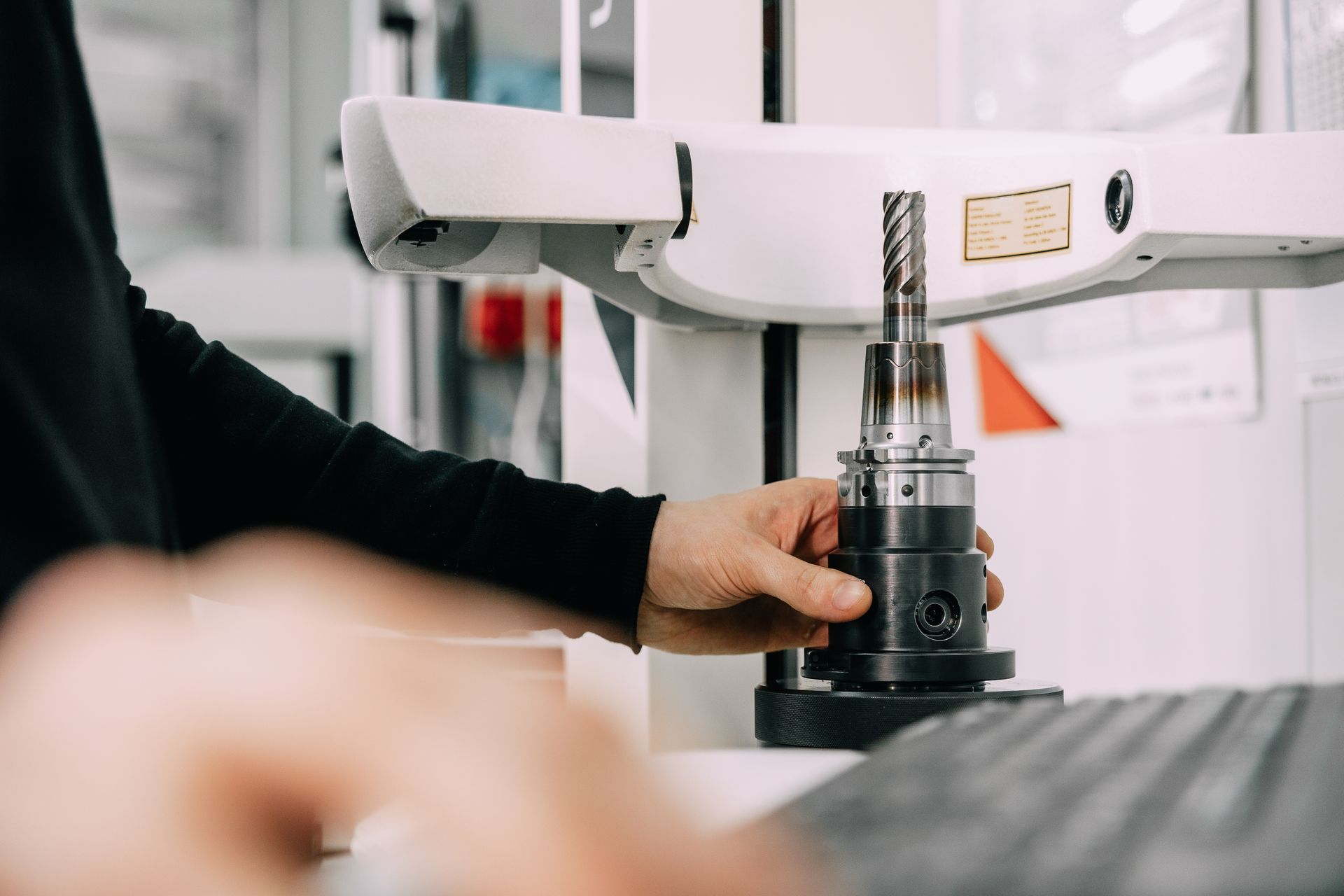
A cutter's colour usually comes from its coating. Titanium nitride (TiN) is gold, TiCN is grey-blue, and TiAlN and AlTiN coatings for high temperatures are violet or graphite. Uncoated cutters have a metallic colour. Some manufacturers also mark material groups with coloured rings on the shank. More in the article PVD Coatings.
How to choose a milling cutter?
Choosing the right tool depends on a few questions:
- workpiece material – steel, aluminium, hardened steel or plastic,
- operation – roughing or finishing, facing, pockets, slots,
- part geometry – deep grooves, complex shapes, holes made by milling,
- machine and clamping rigidity – this limits the diameter and overhang.
For parts with complex shapes, ball-nose cutters and 5-axis machining are used. Cutting parameters are described in How to Select the Cutting Speed When Milling Steel?, and machining of hard materials in Milling and Machining of Hardened Steel Using CNC.
At Sacher CNC we choose milling cutters to suit the material and batch size – a well-chosen cutter shortens cycle time and lowers the cost per part. Details on the CNC Milling.
Types of milling cutters – FAQ
What types of milling cutters are there?
The main milling cutters for metal are end mills, cylindrical, shell end, face, disc, slitting, angle and form cutters. By mounting they are divided into shank cutters and arbor-mounted cutters.
Which milling cutters for metal are best?
There is no single best cutter. Most CNC work uses coated carbide cutters, while HSS is used where vibration and dynamic loads occur.
Which cutter is used for what?
End mills – pockets and contours; cylindrical and face mills – flat surfaces; disc cutters – deep grooves; slitting saws – parting; angle cutters – chamfers and angled grooves; form cutters – profiles.
Which milling cutter is the strongest?
Diamond and CBN cutters are the most wear-resistant, each within its own material group. HSS cutters are the most resistant to impact.