Vacuum hardening is a heat treatment of steel in which steel is heated in a sealed furnace chamber from which the air has been removed and then quenched rapidly in oil or gas – without contact with air. Without oxygen, the surface does not oxidise or decarburise, and the whole process can be controlled precisely. As a result, parts hardened in vacuum furnaces have a clean surface, high hardness and minimal distortion.
Below we explain how the vacuum hardening process works, at what temperature steel is hardened, how oil and gas quenching work, how this method differs from protective-atmosphere hardening, induction hardening and nitriding, and what the cost of the treatment depends on.
Table of contents:
- What is vacuum hardening?
- How does hardening in vacuum furnaces work?
- At what temperature is steel hardened?
- Advantages of vacuum hardening
- Comparison with other heat treatment methods
- Which steels and parts are suitable for vacuum hardening?
- Limitations and risks
- Hardening in series production of CNC parts
- How much does steel hardening cost?
- Vacuum hardening – FAQ
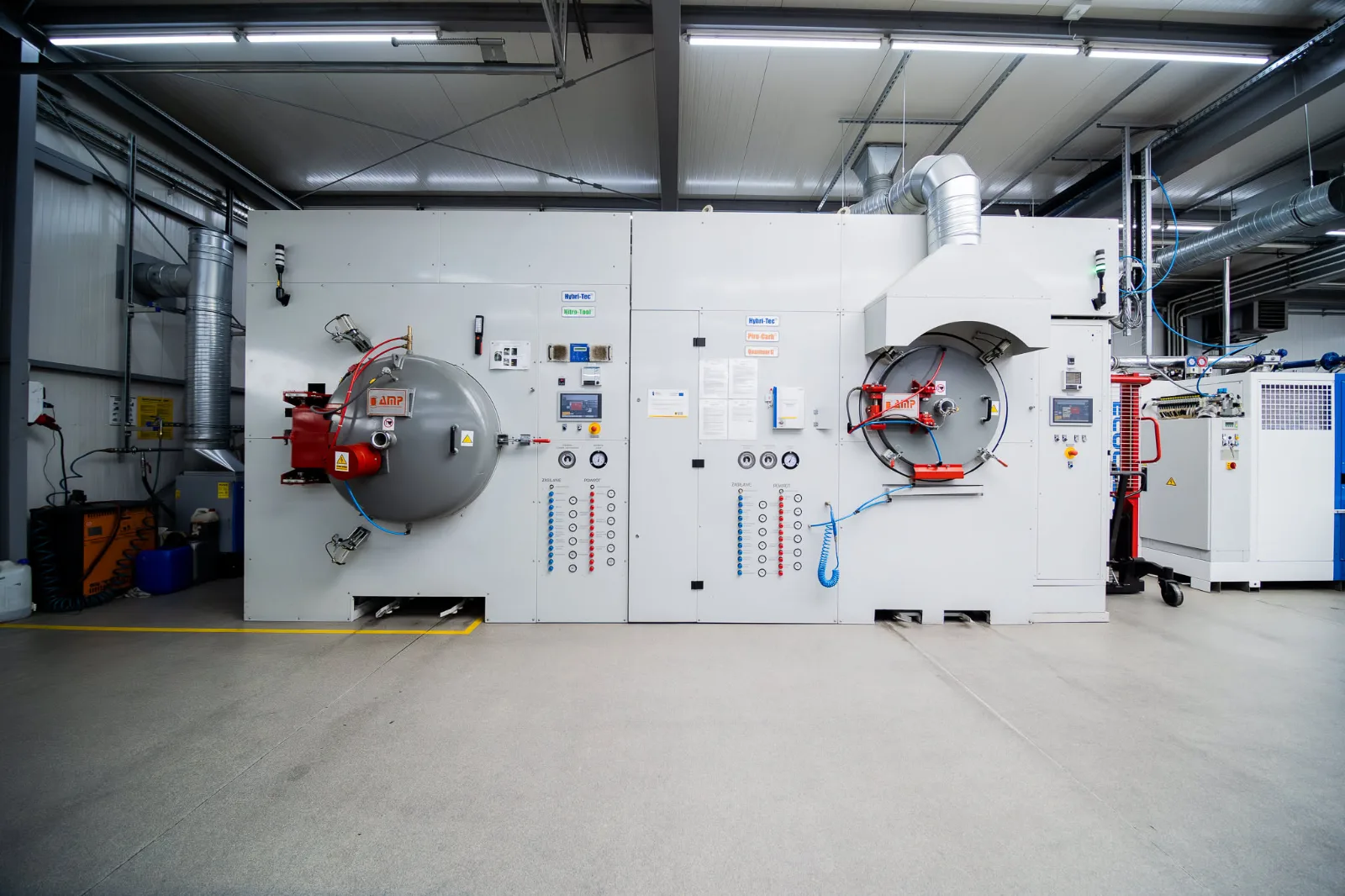
What is vacuum hardening?
Hardening is a heat treatment in which steel is heated to the austenitising temperature, held there and then cooled rapidly. During rapid cooling, austenite transforms into martensite. Martensite changes the microstructure of the steel and increases its hardness and strength. Hardening is always followed by tempering, which reduces brittleness and internal stresses.
In vacuum hardening, what changes is the environment in which the heat treatment takes place. Austenitising is carried out by heating the steel under high vacuum, not in air, a salt bath or a protective atmosphere. Air contains oxygen, water vapour and carbon dioxide, which react with the steel surface at high temperature. The result is scale, discolouration and decarburisation – a loss of carbon that lowers surface hardness. In a vacuum these reactions practically do not occur, so hardening in vacuum furnaces delivers a clean surface and repeatable results.
The general principles of hardening are described in the article Steel Hardening: How Does the Process Work and What Is Its Purpose?.
How does hardening in vacuum furnaces work?
The process consists of several stages, each with its own parameters: temperature, treatment time, gas pressure and cooling rate. They are selected according to the steel grade, wall thickness and drawing requirements.
Preparing the batch
Parts must be clean and dry before treatment. Residues of oil, coolant or paint evaporate in the vacuum and leave marks on the surface. Parts are arranged in the basket so that the cooling gas can flow freely around them and thin, long parts do not bend under their own weight. The batch layout directly affects distortion and hardness distribution across the whole lot.
Preheating and austenitising
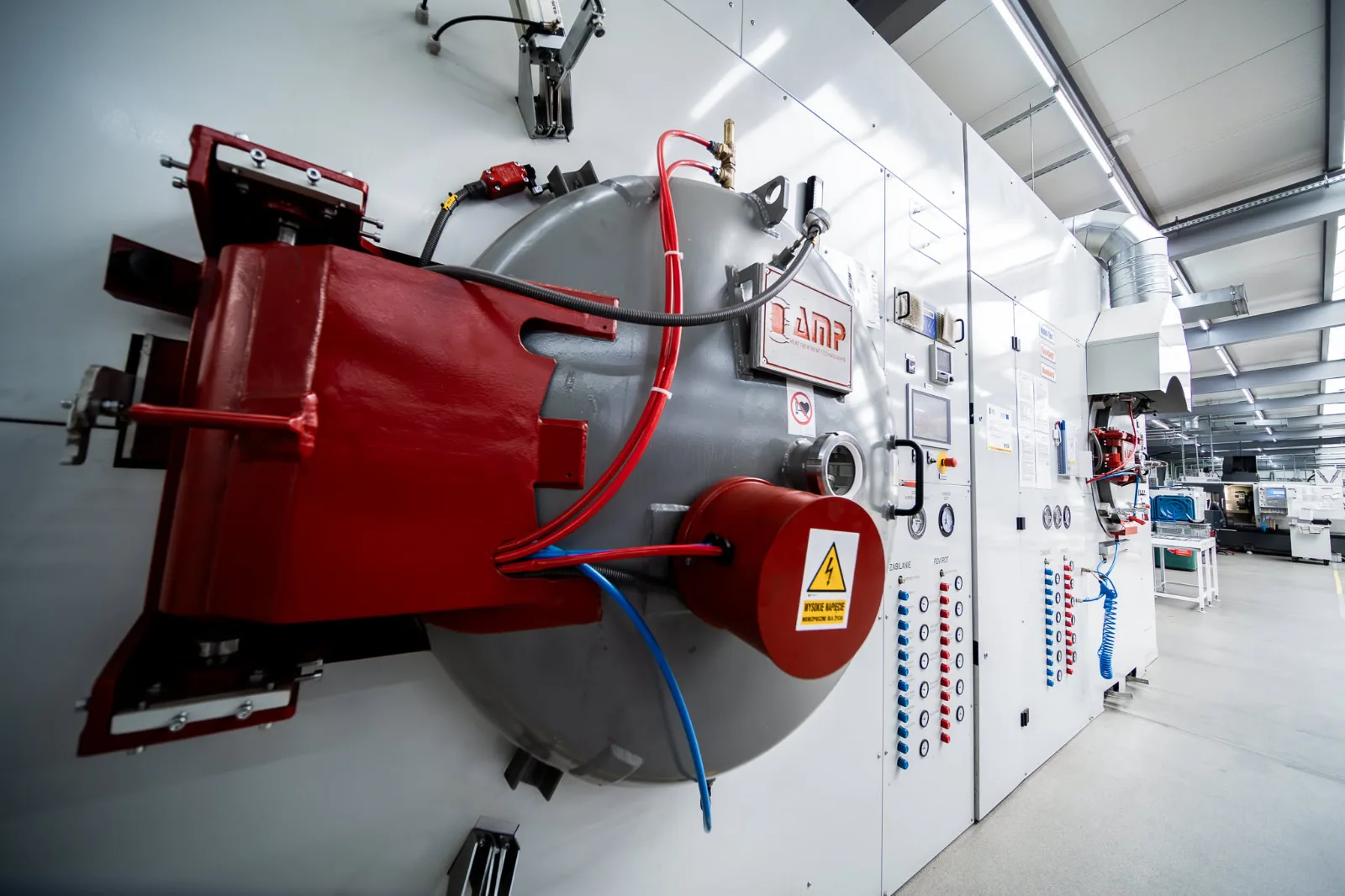
Once the chamber is closed, pumps remove the air and heating begins. Vacuum furnaces transfer heat mainly by radiation, so the steel heats up evenly. Preheating limits thermal stresses in the steel: the batch is held at one or more intermediate steps until surface and core temperatures are equal. This matters for tool steels, which are sensitive to thermal shock and internal stresses. The steel is then soaked at the austenitising temperature for a time chosen according to the part's thickness.
Quenching – oil or gas?
After soaking comes rapid cooling. Vacuum furnaces use two types of quenching: oil or gas. In both cases cooling capacity and parameters must match the steel grade: too slow cooling will not give full hardness, too aggressive cooling increases the risk of cracking.
Oil quenching
After heating in vacuum, the batch is moved into a chamber with quenching oil, still without contact with air. Oil removes heat faster than gas, so it achieves full hardness even in steels with lower hardenability and in thicker sections. The surface does not oxidise, and after the process the parts only need washing. This is how we harden parts at Sacher CNC.
Pressurised gas quenching
Inert gas, usually nitrogen, is fed into the chamber at elevated pressure. Pressurised gas quenching ensures uniform cooling and the lowest distortion. High quenching pressure improves results on thicker sections. This variant suits steels with high hardenability, such as tool steels.
Tempering and sub-zero treatment
Hardened steel is hard but brittle. Tempering – reheating to a lower temperature – reduces stresses and restores some ductility. Tool steels are usually tempered two or three times. Where dimensional stability requirements are high, sub-zero (cryogenic) treatment is also used to help eliminate retained austenite. Details are covered in the article Steel Tempering – Temperature, Duration and Types.
At what temperature is steel hardened?
The hardening temperature of steel is typically around 850–1050°C. The exact value depends on the steel grade and its carbon and alloy content. Quenching and tempering steels are hardened at the lower end of this range, tool steels higher, and high-speed steels require temperatures above 1100°C. Recommended values are given by the material manufacturer in the grade's data sheet.
Vacuum hardening allows precise control of the heat treatment process. Thermocouples in the batch measure core and surface temperatures, and the controller runs the cycle according to a stored programme. Measuring and recording the parameters of every batch supports quality control and repeatability between lots.
Advantages of vacuum hardening
This method is chosen when surface quality, dimensions and repeatability matter. The main advantages are:
- Clean, scale-free surface. Hardening in vacuum furnaces gives a clean surface, so parts need no blasting or pickling – after oil quenching, washing is enough.
- No decarburisation. Vacuum hardening eliminates decarburisation of the surface layer, so surface hardness matches the hardness deeper in the material.
- Low distortion. Minimal distortion during hardening improves dimensional accuracy and allows smaller grinding allowances.
- High hardness. Hardening raises the hardness of tool steels up to around 70 HRC, depending on the grade.
- Wear and fatigue resistance. Heat treatment improves wear resistance and fatigue strength, and quenching and tempering extends the service life of machine components.
- Dimensional stability. Correct hardening and tempering gives the part high dimensional stability in service.
- Choice of quenching. Oil or gas is selected to suit the steel grade and section.
- Safety and environment. The process needs no salt baths or flammable protective atmospheres.
As a result, hardening reduces the cost of replacing parts in production: hardened components keep their dimensions longer and machines last longer.
Comparison with other heat treatment methods
The effectiveness of hardening depends on how heating and cooling are carried out. Vacuum furnaces do not replace every method – each technology has its uses, and the choice depends on material, shape and requirements.
Protective-atmosphere and salt-bath hardening
In conventional furnaces the batch is heated in a protective atmosphere and then quenched in oil. Here it is harder to avoid discolouration and partial decarburisation. Salt baths heat quickly, but parts must be cleaned thoroughly of salt afterwards. Vacuum hardening with oil quenching combines a clean surface with a high cooling rate.
Induction hardening
Induction hardening is a form of surface hardening that covers only a selected zone. Current induced by a coil heats the surface layer, followed by a quenching spray. Induction hardening enables selective hardening of zones such as shaft journals, raceways or gear teeth. The short heating time suits high-volume production, but it requires dedicated inductors and does not give uniform hardness through the section. Hardening in vacuum furnaces is through-hardening of the whole part.
Nitriding
Nitriding is a thermochemical treatment. Nitrogen atoms diffuse into the steel surface and form a hard, wear-resistant layer. Nitriding produces a layer with hardness equivalent to up to around 70 HRC. The nitriding temperature is much lower than the hardening temperature, so distortion after nitriding is very small. However, the nitrided layer is usually only fractions of a millimetre thick, and the core keeps the hardness it had before. That is why the two processes are often combined: first hardening and tempering, then nitriding, which further increases wear and corrosion resistance. The differences are explained in Nitriding vs Carburizing, and vacuum carburizing in What Is the Vacuum Carburizing Process All About?.
Which steels and parts are suitable for vacuum hardening?
Gas quenching requires steels with good hardenability, while oil quenching extends the range to steels with lower hardenability. Suitable for vacuum hardening are, among others:
- cold-work tool steels (e.g. 1.2379),
- hot-work tool steels (e.g. 1.2343),
- high-speed steels (e.g. 1.3343),
- martensitic stainless steels,
- alloyed engineering steels, quenching and tempering steels and bearing steels.
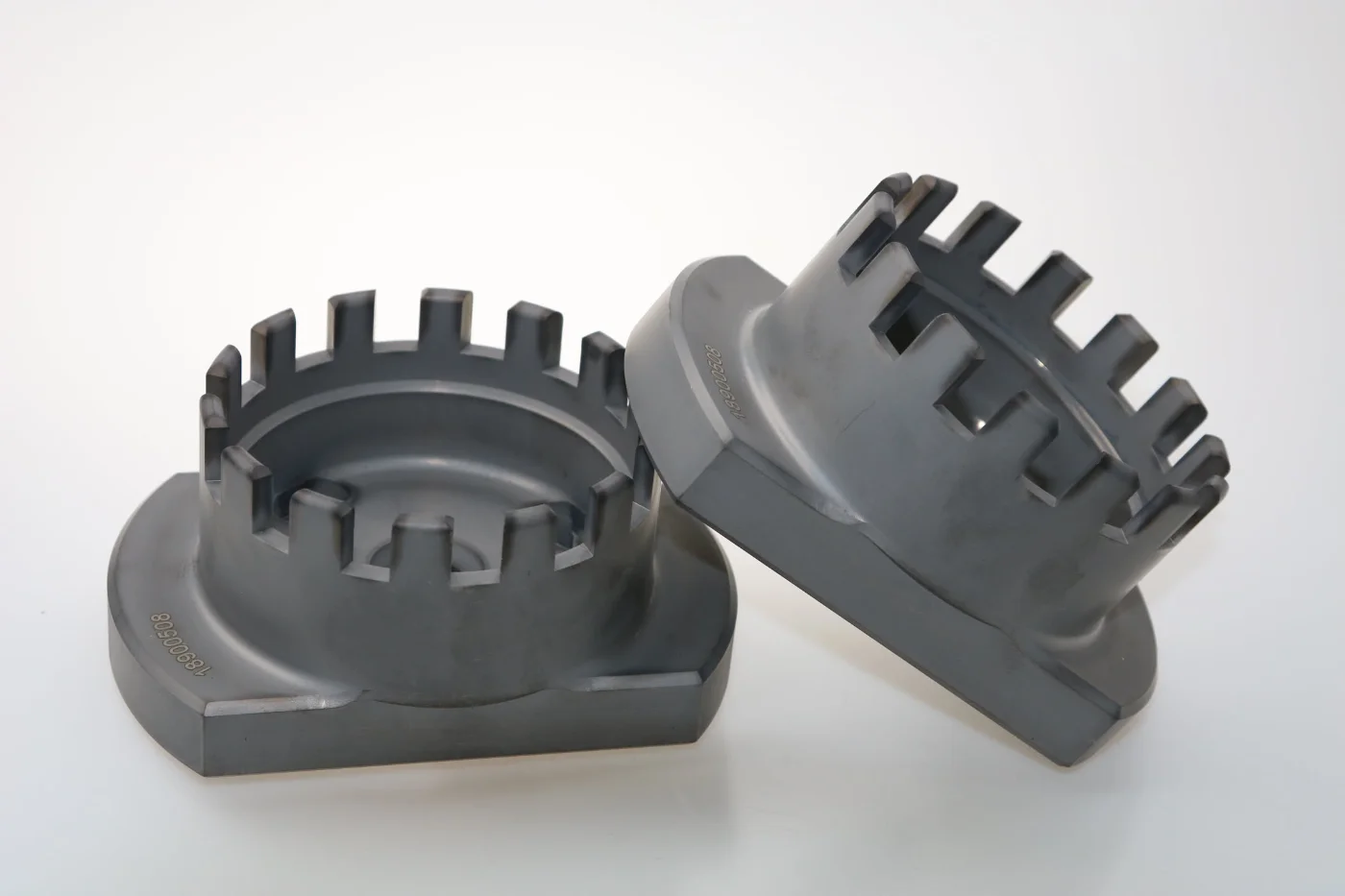
Typical products are cutting tools, blanking dies, stamping dies, punches and moulds. Hardening is key in the production of injection moulds, where hardness, polishability and stable insert dimensions matter. Manufacturers of machine components, gearboxes and hydraulics also use vacuum hardening. When only a selected zone of the part needs to be hard, induction hardening is often the better choice.
Limitations and risks
Parts with strongly varying wall thickness cool unevenly, which brings a risk of distortion and, in extreme cases, cracking. This applies especially to sharp corners, undercuts and holes close to edges. That is why designers should take heat treatment into account at the design stage: round transitions and plan allowances.
Large parts need longer soaking and a furnace with sufficient working space. Heating power and quenching pressure limit the batch weight and the section that will harden through. More on this in How to Perform Heat Treatment for Large Components?.
For this reason it is worth giving the hardening shop a drawing with the steel grade, required hardness and tolerances, so the process parameters can be matched to the specific part.
Hardening in series production of CNC parts
In contract manufacturing, hardening is usually followed by finishing to final dimensions. A typical sequence is: milling or turning with allowance, sometimes stress-relief annealing, hardening and tempering, and finally grinding or EDM. Thanks to low distortion, allowances can be smaller, which shortens machining time and improves the efficiency of the whole process. Machining after hardening is covered in Milling and Machining of Hardened Steel Using CNC.
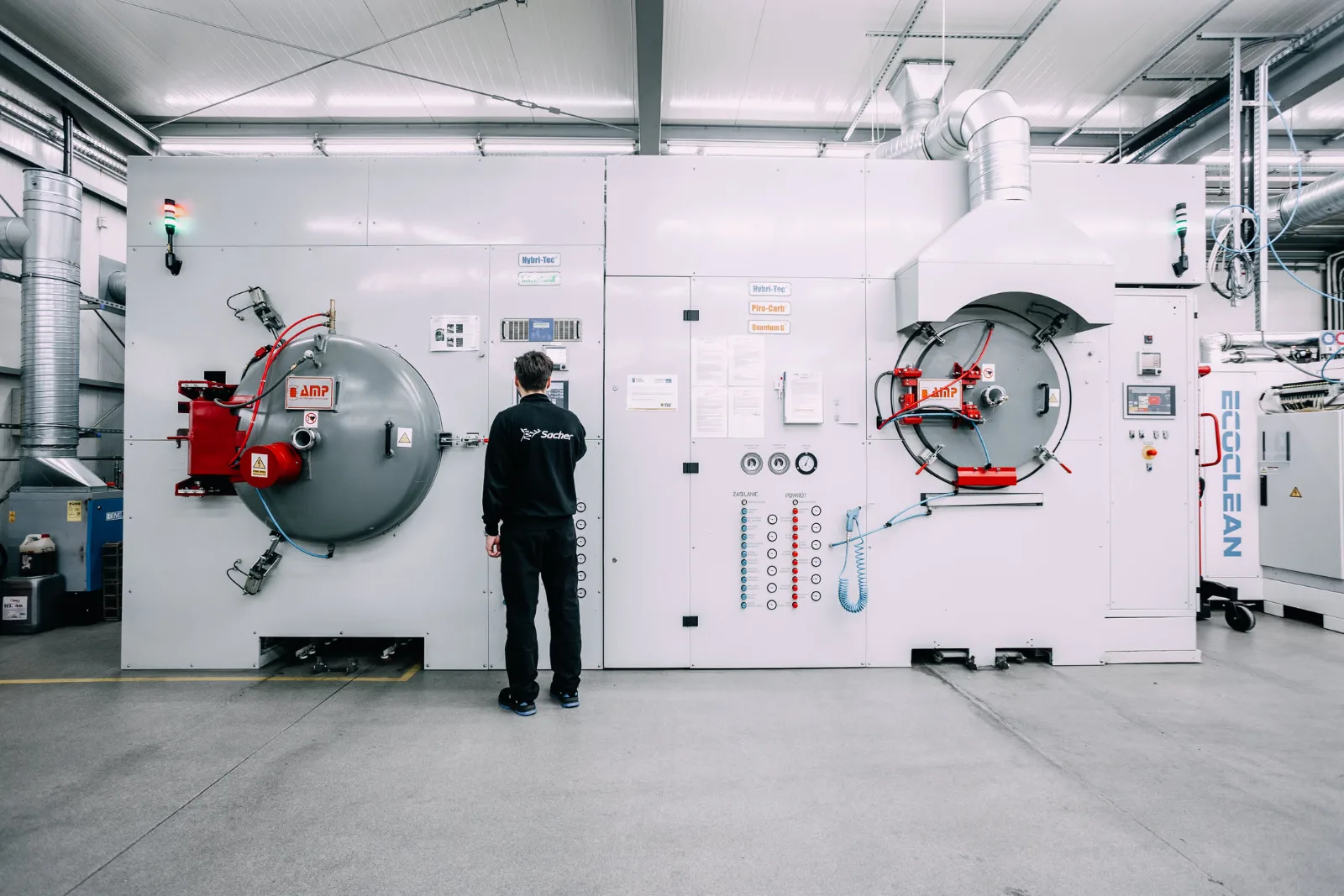
Sacher CNC has its own hardening shop with vacuum furnaces and oil quenching, where we carry out hardening, carburizing, tempering and plasma nitriding. Milling, turning, heat treatment, grinding and finishing are done in one plant. This shortens lead times, eliminates transport between subcontractors and lets one team take responsibility for the dimensions and hardness of the finished part. This is especially important for medium and large series, where repeatability between lots counts. Details are on the Heat Treatment and CNC Grinding.

How much does steel hardening cost?
Hardening is quoted individually, because the cost depends on a number of factors:
- steel grade – determines the temperature, soaking time and number of tempering cycles,
- weight and dimensions of the parts and how well they fill the furnace,
- quantity – in a series the cycle cost is spread over more parts, lowering the cost per part,
- quality requirements – tight hardness tolerances, sub-zero treatment, measurement reports,
- further operations, such as grinding after hardening.
For a quote, a technical drawing with the steel grade, required hardness and quantity is enough.
Vacuum hardening – FAQ
Below we answer the questions customers ask most often.
What does the hardening process involve?
Steel is heated to the austenitising temperature, held, cooled rapidly to form martensite and then tempered. In vacuum hardening, heating takes place in a vacuum and quenching in oil or gas, without contact with air.
At what temperature is steel hardened?
Most steels are hardened at around 850–1050°C. High-speed steels require temperatures above 1100°C. Exact values are given in the material data sheet for the grade.
How can you harden steel yourself?
Plain carbon steel can be hardened in a workshop by heating it with a torch and quenching it in oil. However, this gives no temperature control, causes scale and decarburisation, and hardness is often uneven. Vacuum hardening cannot be done at home, so production parts should be sent to a hardening shop.
Do parts need grinding after vacuum hardening?
Not always. Distortion is small, but with tight tolerances functional surfaces are usually ground to size.
How does vacuum hardening differ from nitriding?
Hardening treats the whole cross-section of the part at high temperature. Nitriding creates a thin, hard surface layer at a lower temperature. The two processes are often combined.