
Cutting inserts are indexable cutting edges made of cemented carbide, cermet, ceramics, CBN or PCD, clamped in turning tools, milling cutters and indexable drills. They are used in almost every machining operation. Their selection determines surface quality, machining time and the cost of a single part, especially in series production.
For process engineers, designers and purchasing departments, we explain the types of inserts, how to read the ISO designation, what the grades P, M, K, N, S, H mean and how to choose an insert for the material and operation.
Table of contents:
- What are cutting inserts?
- Types of cutting inserts
- Insert materials and coatings
- ISO designation of cutting inserts
- Insert grades – ISO material groups
- How to choose a cutting insert?
- Cutting inserts at Sacher CNC
- Cutting inserts – FAQ
What are cutting inserts?
A cutting insert is a small insert with several cutting edges. When one edge wears out, the insert is rotated or turned over and the next edge is used. This means the tool does not need regrinding, and the dimension stays repeatable after an insert change.
The way an insert works depends on its shape, clearance angle, chip breaker and corner radius. They determine how the insert cuts, how it forms the chip and what depth of cut it can handle.
Types of cutting inserts
The insert type is chosen mainly for the operation. Turning, milling and drilling inserts differ in shape, clamping method and geometry.
Turning inserts for turning tools
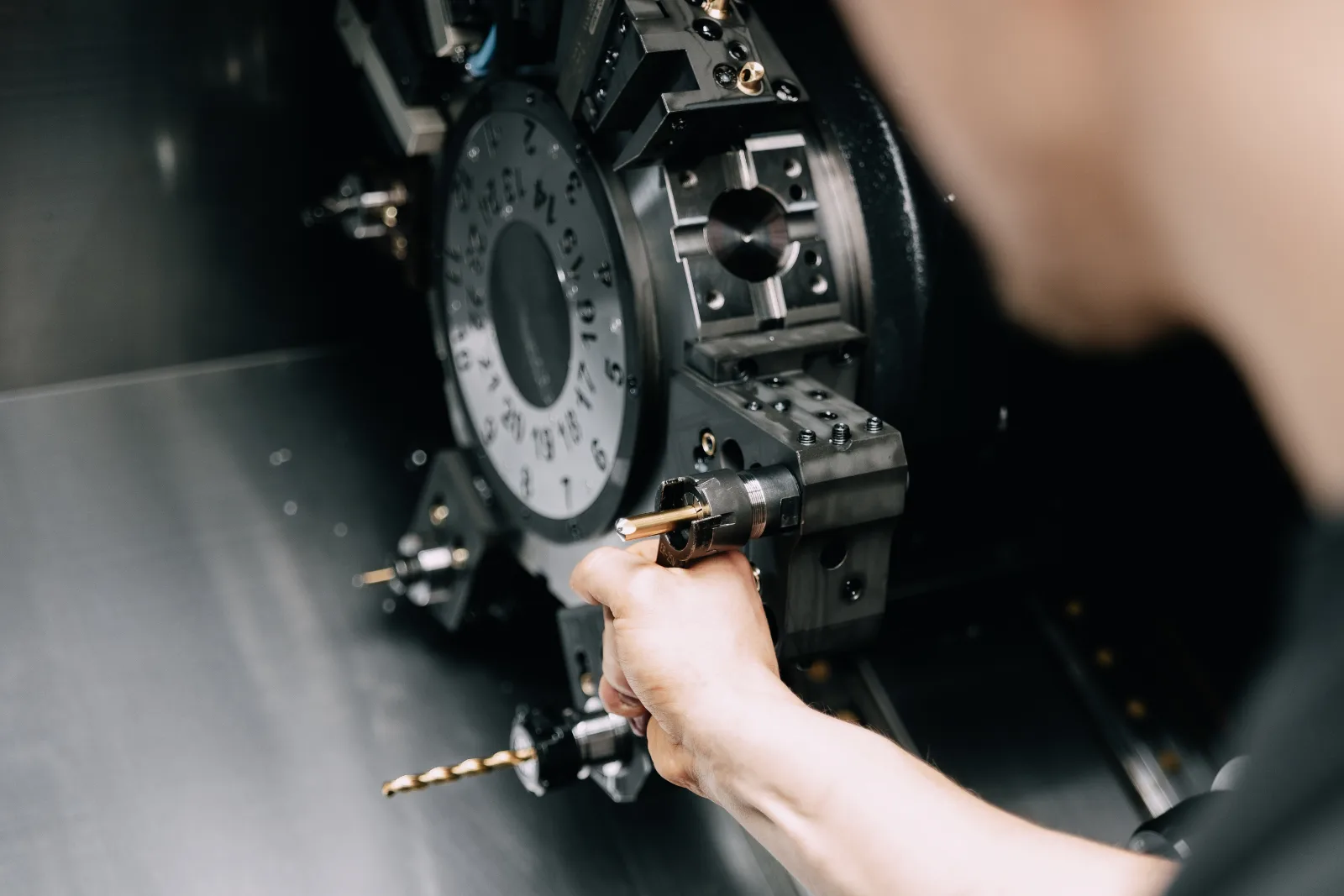
Turning inserts are clamped in turning tools for external and internal turning. The most popular are CNMG, DNMG, WNMG and VBMT.
Milling inserts
Face mills and indexable milling cutters use inserts such as APMT, APKT, SEKT and round RDMT inserts.
Inserts for indexable drills
Indexable drills usually use SPMT or WCMX inserts. One insert machines the centre of the hole, the other its periphery.
Grooving, parting and threading inserts
Narrow inserts are used for grooves and parting off, and inserts with a thread profile for thread turning.
Positive and negative inserts
Inserts are also divided into single-sided (positive, with a clearance angle) and double-sided (negative, without a clearance angle). Negative inserts have twice as many edges and cope better with roughing. Positive inserts cut more easily and work better in finishing, on thin walls and in non-ferrous metals.
Round and square inserts are the strongest. The 80° rhombus (C) is universal, while the 55° (D) and 35° (V) rhombuses allow profile turning. The triangle (T) has three edges on each side but a weaker corner, so triangular inserts are used mainly for lighter turning.
Insert materials and coatings
The most common material is cemented carbide, i.e. tungsten carbide in a cobalt binder. Cemented carbide retains its hardness at high temperature and copes well with variable loads. Other materials are:
- cermet – for finishing steel, gives good surface quality,
- ceramics – for cast iron and heat-resistant alloys at high speeds,
- CBN (cubic boron nitride) – for hardened steel, usually above approx. 45 HRC,
- PCD (polycrystalline diamond) – for aluminium, copper and composites, but not for steel.
Most cemented carbide inserts are coated. CVD coatings, e.g. Al2O3, are thicker and protect against heat and abrasion, so they work well in turning steel and cast iron. PVD coatings, e.g. TiAlN, are thinner and keep the edge sharp, which helps with stainless steel and milling. Cemented carbide inserts for aluminium have a sharper geometry and a polished rake face, often without a coating.
ISO designation of cutting inserts
The designation of cutting inserts is defined by ISO 1832. The first positions of the code are the same for all manufacturers. Example – the turning insert CNMG 120408:
- C – shape: 80° rhombus,
- N – clearance angle 0°, i.e. a negative insert,
- M – tolerance class,
- G – fixing hole and chip breaker on both sides,
- 12 – cutting edge length (approx. 12.9 mm, inscribed circle 12.7 mm),
- 04 – thickness 4.76 mm,
- 08 – corner radius 0.8 mm.
After this code the manufacturer adds its own chip breaker and grade symbol.
Corner radius
A smaller corner radius gives lower forces and is better for finishing, while a larger one strengthens the edge in roughing.
Insert grades – ISO material groups
An insert grade is a combination of substrate and coating. Manufacturers assign grades to ISO material groups, marked with a letter and colour:
- P (blue) – steel,
- M (yellow) – stainless steel,
- K (red) – cast iron,
- N (green) – aluminium and other non-ferrous metals,
- S (orange) – heat-resistant alloys and titanium,
- H (grey) – hardened materials.
The number after the letter, e.g. P10 or P30, indicates wear resistance or toughness. A lower number means a harder grade for fast finishing, a higher one a tougher grade for roughing and interrupted cuts.
How to choose a cutting insert?
It is worth selecting cutting inserts in this order:
- Operation – turning, milling, drilling, grooving or threading.
- Material – the ISO group of the workpiece material determines the insert grade.
- Machining range – for roughing a strong shape, large radius and a chip breaker for high feeds; for finishing a sharp geometry and small radius.
- Shape and size – the largest corner angle that still allows the part shape to be machined, and an insert size and thickness matched to the depth of cut.
- Parameters – cutting speed and feed according to the manufacturer's catalogue, then fine-tuning on the machine.
Finally, it is worth assessing insert wear. Chipping of the edge indicates a grade that is too hard or vibration, while rapid flank wear indicates too high a speed or a grade that is too soft. We write more about parameters in the article How to choose the cutting speed when milling steel.
Cutting inserts at Sacher CNC
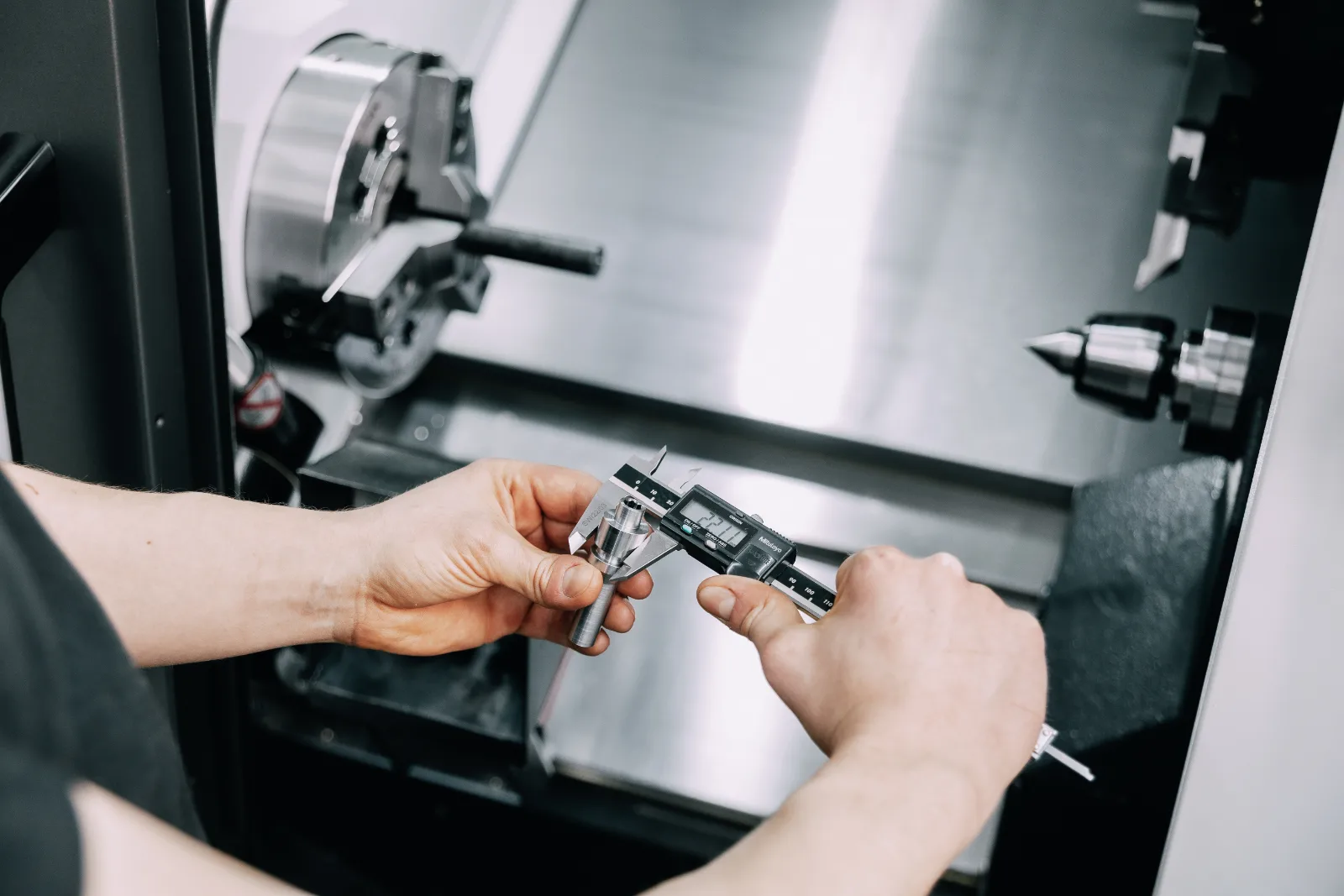
At Sacher CNC we select machining inserts for each series: for the material grade, part shape and quantity. For medium and large series we test the geometry and parameters on the first parts and then keep them until the end of the series. We carry out CNC turning and CNC milling of parts made of steel, stainless steel, aluminium and hardened steel. More about materials in the article Steel processing – types, methods and applications.
Cutting inserts – FAQ
Below we answer the questions that come up most often when selecting inserts.
What does the colour of a cutting insert mean?
The colour in the catalogue indicates the ISO group: blue – steel (P), yellow – stainless steel (M), red – cast iron (K), green – non-ferrous metals (N), orange – heat-resistant alloys (S), grey – hardened materials (H).
Are cemented carbide inserts suitable for hardened steel?
Yes, in H-group grades with a hard substrate and a suitable coating. For higher hardness and finishing, CBN inserts are usually a better choice because they hold size longer.
Which turning inserts are the most universal?
CNMG and WNMG inserts are most commonly used for turning steel. They are negative, have several edges on each side and work from roughing to semi-finishing.