
Sinker EDM and wire EDM are two variants of electrical discharge machining. Both remove material with electrical discharges, so the hardness of the material does not matter, but each suits different shapes. Sinker EDM creates cavities and recesses of any shape, while wire EDM cuts through-contours. Both methods are used in many industries wherever accuracy and machining of hard materials count.
This article is for designers, process engineers and toolrooms that order punches, dies, moulds and hardened steel parts. We explain how both methods work, how they differ and when to choose each one.
Table of contents:
- The EDM process – how does electrical discharge machining work?
- How does sinker EDM work?
- How does wire EDM work?
- Sinker EDM vs wire EDM – differences
- Applications of sinker and wire EDM
- EDM at Sacher CNC
- EDM – FAQ
The EDM process – how does electrical discharge machining work?
Electrical discharge machining (EDM) uses a series of electrical discharges between an electrode and the workpiece. Both are immersed in a dielectric, with a very small gap kept between them. When the electric field strength exceeds the strength of the dielectric, a discharge occurs. Each discharge melts and vaporises a tiny amount of material, which the dielectric flushes out of the gap.
The electrode does not touch the part, so there are no cutting forces in the process. It is an advanced method that allows precise material removal without distorting thin walls. The only condition is that the material conducts electricity. We write more about the process itself in the article What does the process of electrical discharge machining (EDM) involve?
How does sinker EDM work?
Sinker EDM uses a shaped electrode, usually made of graphite or copper. The electrode is the negative of the cavity to be produced and is usually made by milling. During sinking, the electrode moves into the material and its shape is reproduced in the part. The process runs in an oil-based dielectric.
Sinker EDM can produce blind cavities, ribs, sharp internal corners, fine grooves and surface textures that cannot be milled. The method suits complex shapes in tool steel, cemented carbide and other difficult-to-machine materials, including where walls meet at an acute angle. Its drawback is time: preparing electrodes and the sinking itself take longer than machining, and the electrode wears. That is why larger cavities use several electrodes – a roughing and a finishing one.
How does wire EDM work?
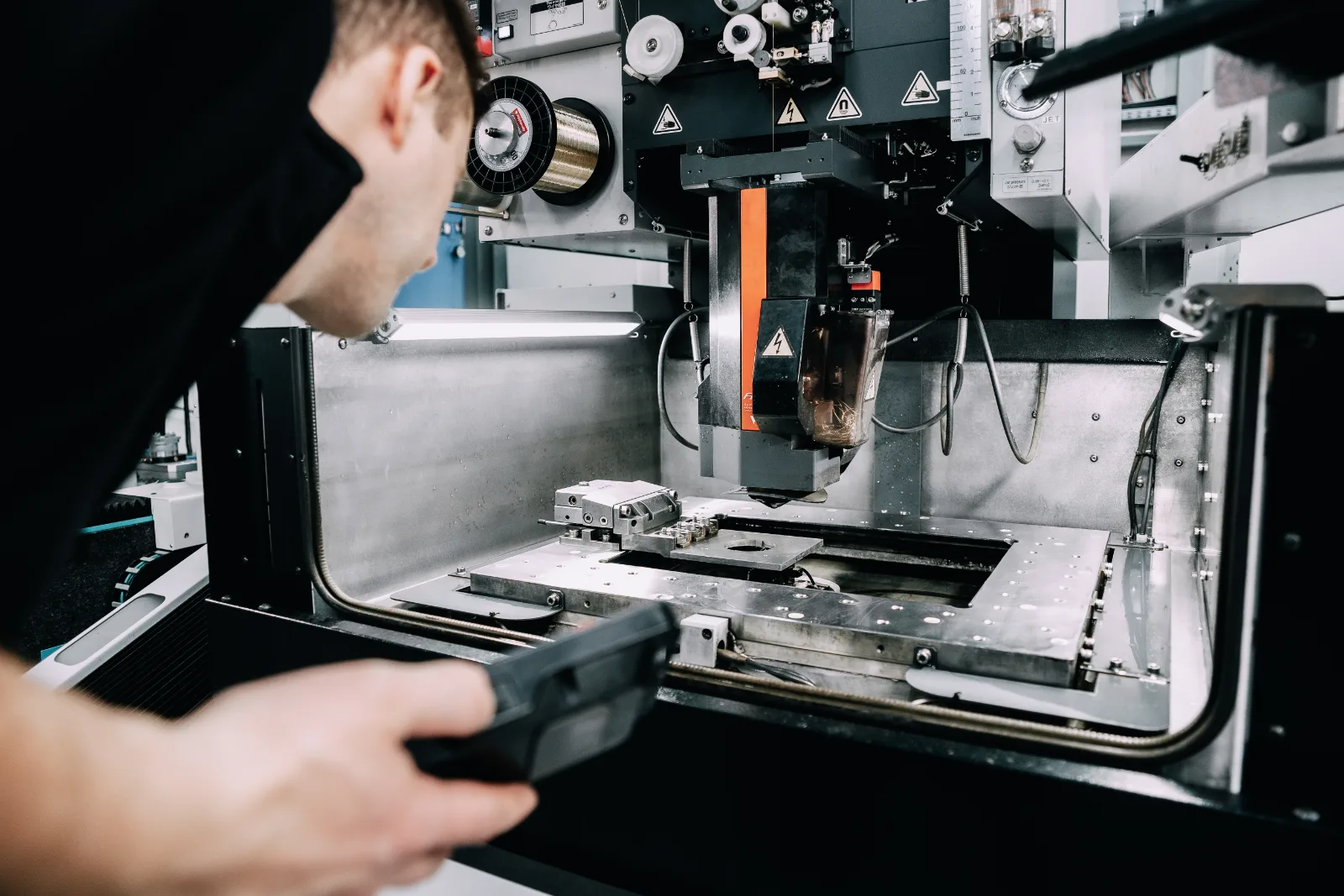
In wire EDM the electrode is a thin wire, usually brass or coated, typically 0.1–0.3 mm in diameter. The wire runs from one spool to another, so a fresh section constantly enters the cutting zone. The dielectric is usually deionised water.
Wire cutting is similar to cutting a contour with a fretsaw: the wire passes through the whole part and cuts any through-contour, including tapers. Internal contours need a start hole. Thanks to several finishing passes the method works with high precision and gives smooth surfaces, so it is well suited to tight tolerances. This technology produces high-precision contours in metals of high hardness.
Sinker EDM vs wire EDM – differences
| Sinker EDM | Wire EDM | |
|---|---|---|
| Electrode | shaped, graphite or copper | brass or coated wire |
| Shape | blind cavities, recesses, ribs | through-contours, also tapered |
| Dielectric | oil | deionised water |
| Preparation | an electrode must be made | a program and a start hole are enough |
| Typical parts | mould cavities, channels, textures | punches, dies, blanking dies, templates |
The choice depends on the shape. If the contour goes through the whole part, wire cutting is faster and cheaper. When a blind cavity or a sharp corner inside a pocket is needed, sinker EDM is required. Many tools use both methods – the wire cuts the punch contour and sinker EDM produces the cavities in the die.
Applications of sinker and wire EDM
EDM is used wherever traditional methods such as turning or milling cannot be applied because of the high hardness of the material or the shape of the part. Most often for:
- tooling elements for stamping: punches, dies and blanking dies,
- production of injection moulds and die-casting moulds,
- hardened steel machine parts, including grooves and non-round holes,
- production of components for the aerospace, automotive and medical industries,
- shaping of cutting tools, e.g. carbide form tools,
- repair and regeneration of tools.
The need to machine after hardening is not a problem, because EDM can machine steel with a hardness above 60 HRC. This removes the risk of distorting the part during heat treatment after the shape has been made. Where requirements are high, the recast layer left on the surface is removed with further finishing passes or polishing.
EDM at Sacher CNC
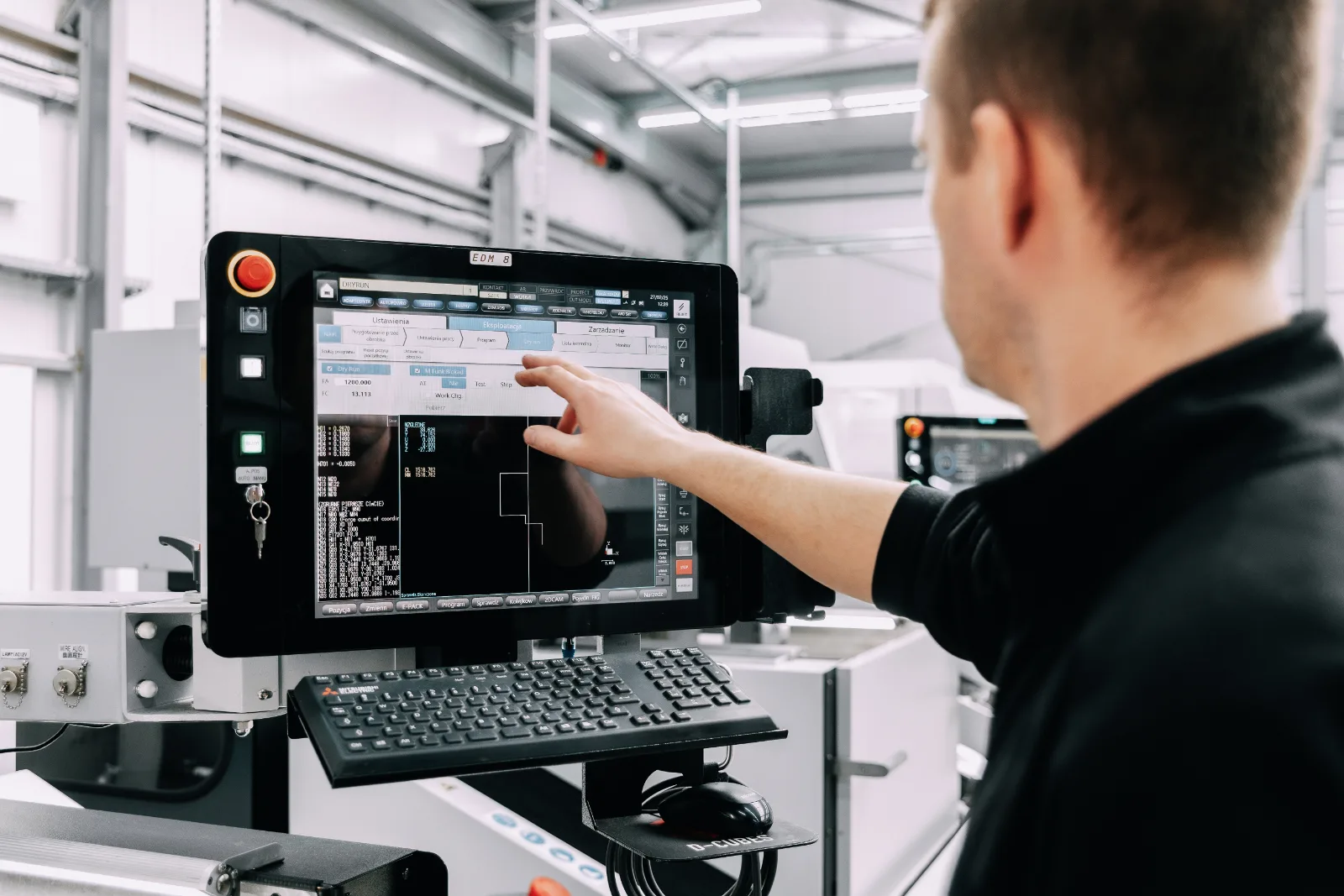
At Sacher CNC we carry out wire and sinker EDM in the same plant as milling, turning and grinding. This lets us rough-machine a part, harden it in our own hardening shop and then use EDM to produce contours requiring precise cutting and cavities in the workpiece. We make both single parts and medium and large series of parts, as well as tooling elements. More about the service on the Electrical discharge machining and Dies and stamping toolspages.
EDM – FAQ
How does a sinker EDM machine work?
A sinker EDM machine has a spindle with the electrode, a tank with dielectric and a pulse generator. The CNC control keeps a constant gap between the electrode and the part and lowers the electrode as material is removed, while the dielectric flushes out the products of the electrical erosion.
Which materials can be machined by EDM?
EDM is suitable for machining electrically conductive materials: hardened and tool steel, cemented carbide, titanium, nickel alloys, copper and aluminium. Plastics and non-conductive ceramics cannot be machined with this method.