Steel tempering is a heat treatment carried out after hardening. It involves heating hardened steel to a set temperature below the transformation point, holding it there and then cooling it. The aim of tempering is to relieve hardening stresses, reduce brittleness and obtain the required properties: hardness, strength and toughness.
We explain what steel tempering is, what types of tempering there are, at what temperature and for how long steel is tempered, and what temper embrittlement is.
Table of contents:
- What is steel tempering?
- Why does hardened steel need tempering?
- Transformations during tempering
- Types of steel tempering
- At what temperature is steel tempered?
- How long should steel be tempered?
- Multiple tempering and secondary hardness
- Temper embrittlement
- Quality control after tempering
- What to specify when ordering hardening and tempering
- Hardening and tempering at Sacher CNC
- Steel tempering – FAQ
What is steel tempering?
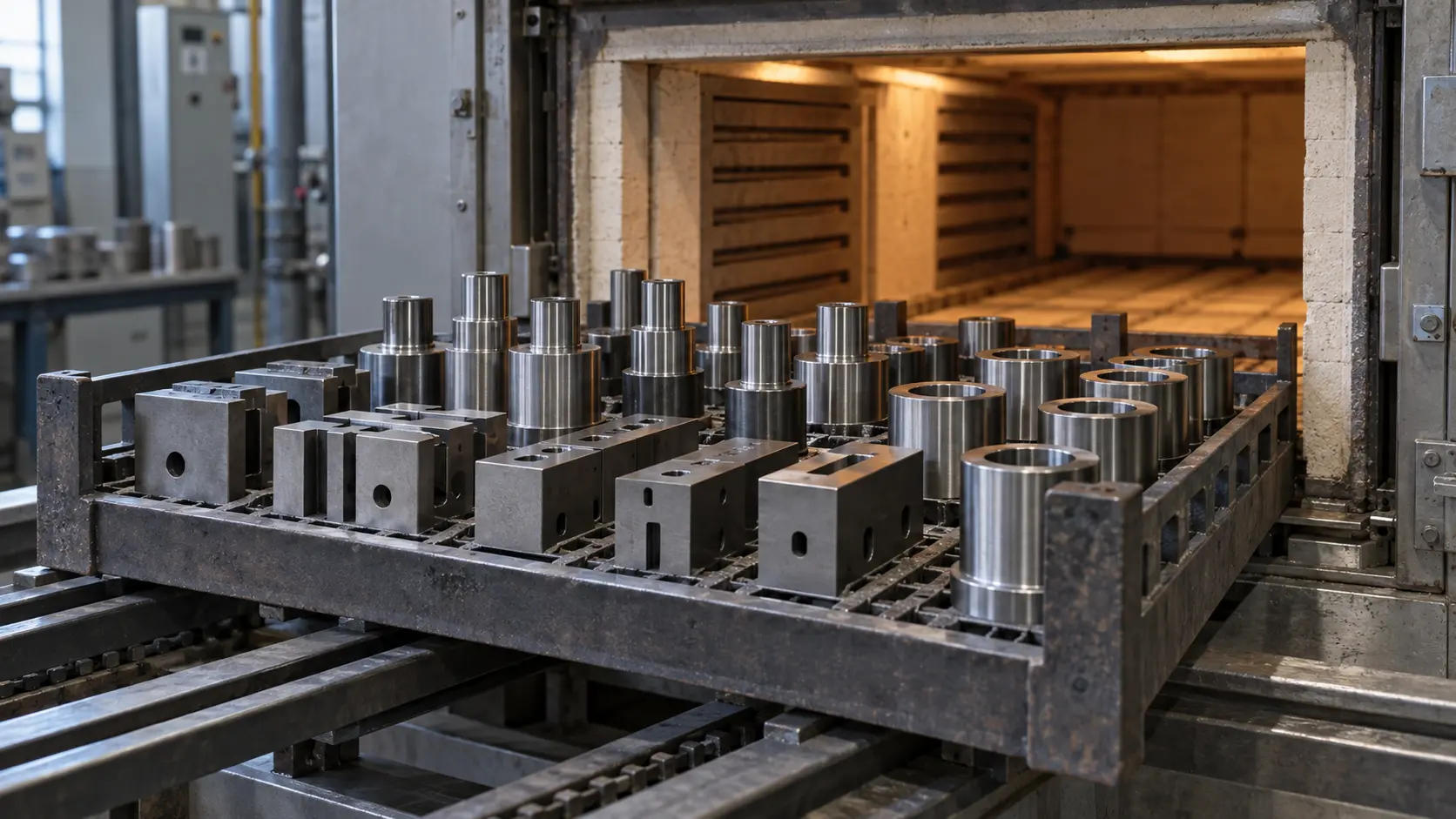
Tempering means reheating a previously hardened part to a temperature lower than the hardening temperature, usually in the range of 150–650°C and always below about 700°C. The steel is held at this temperature and then cooled. Tempering therefore has three stages: heating, holding and cooling. The aim is to obtain the material properties the design requires.
Tempering is a key stage of heat treatment – without it, heat treatment of steel is incomplete. Hardening alone gives high hardness, but the steel is brittle and full of stresses. Only the combination of hardening and tempering delivers high strength while keeping adequate crack resistance. Hardening followed by high-temperature tempering is called quenching and tempering.
More about hardening itself in the article Steel Hardening: How Does the Process Work and What Is Its Purpose?.
Why does hardened steel need tempering?
During hardening, rapid cooling forms martensite – a hard but brittle structure. Uneven cooling of the surface and core creates internal stresses. Internal stresses and the martensitic structure mean that hardened steel cannot be used straight away. Without tempering, a part could crack in service or even while in storage.
That is why every hardened steel needs tempering, and tempering is carried out as soon as possible after hardening. The aims of tempering are:
- relief of hardening and residual stresses,
- lower brittleness and higher ductility,
- better impact toughness and crack resistance,
- dimensional stabilisation of the part,
- setting the steel's hardness to the required level.
Tempering enables a part to withstand dynamic and alternating loads without cracking, and gives the best compromise between hardness and ductility.
Transformations during tempering
The transformations during tempering depend on temperature. As the temperature rises, martensite in hardened steel decomposes and fine carbides precipitate. At lower temperatures tempered martensite forms, at medium temperatures tempered troostite, and at high temperatures tempered sorbite. Retained austenite left after hardening transforms into martensite or bainite.
The higher the temperature, the lower the internal stresses and the higher the ductility – but also the lower the hardness. A higher tempering temperature reduces steel hardness, so choosing it is always a trade-off between hardness and toughness.
Types of steel tempering
Types of steel tempering are classified by temperature range: low, medium and high tempering. The temperature limits are approximate – actual parameters depend on the steel grade.
Low-temperature tempering (150–250°C)
Low-temperature tempering keeps high hardness and wear resistance while relieving stresses. Typical applications are cutting tools, blanking dies, gauges, carburised parts and bearings. It is used for tool steels and wherever high surface hardness must be maintained.
Medium-temperature tempering (250–500°C)
Medium-temperature tempering gives a high elastic limit. It is used for springs, leaf springs and elastic components. Tempered troostite forms in this range, and hardness drops more noticeably than with low tempering.
High-temperature tempering (500–650°C)
High-temperature tempering gives a good combination of strength and toughness. Hardening with high tempering is quenching and tempering – the basic treatment for quenched and tempered steels. After it, the steel has a high-strength core and good impact toughness. High tempering is used for machine parts working under heavy and alternating loads, such as shafts, axles, gears, pins and bolts. Gears are often additionally surface-hardened after quenching and tempering. These are impact-loaded parts for which toughness matters more than maximum hardness.
At what temperature is steel tempered?
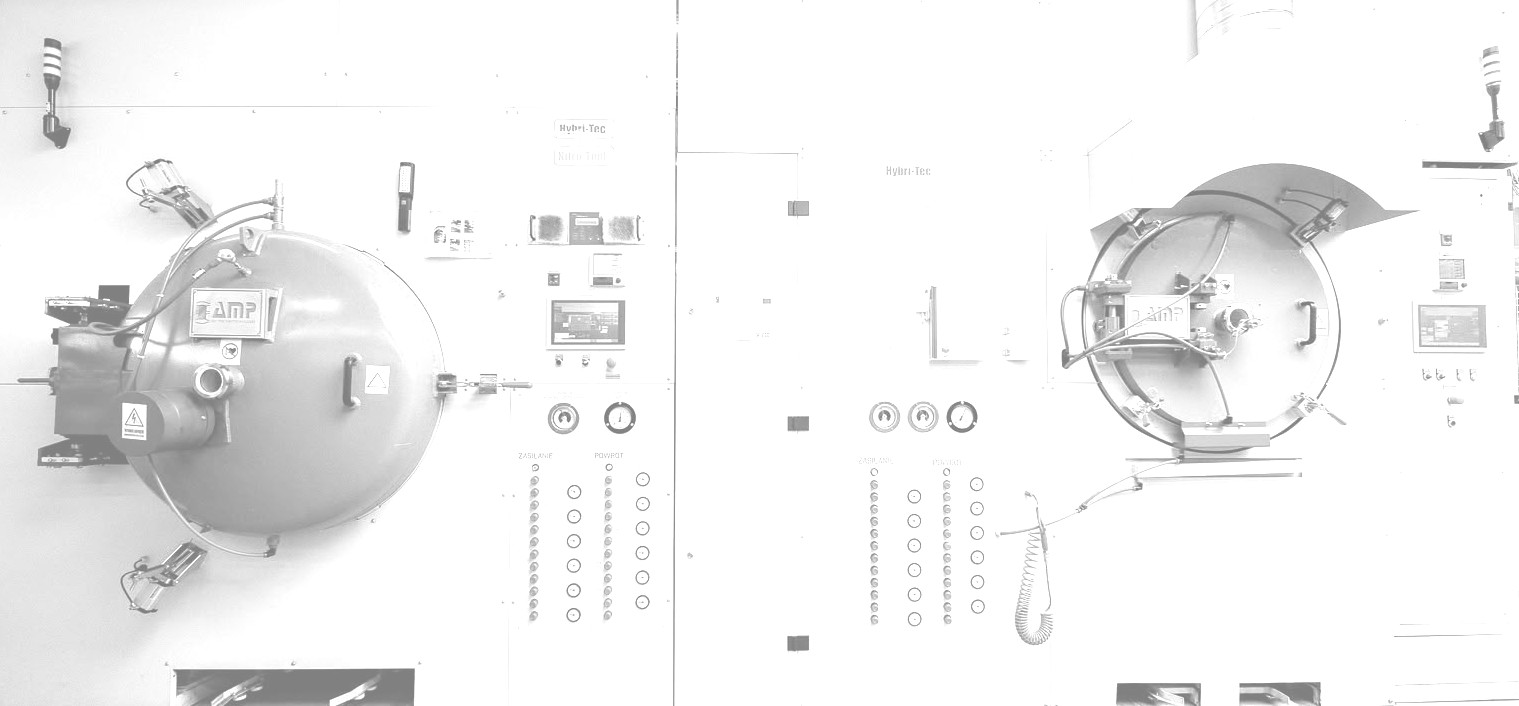
Steel is tempered in the 150–650°C range. The right temperature depends on the steel grade and the required hardness. Chemical composition, especially carbon and alloy content, changes the steel's resistance to tempering: alloy steels lose hardness more slowly than carbon steels.
For each steel grade, the manufacturer provides a tempering curve showing hardness versus temperature, which is used to select the tempering temperature for the required hardness. Values from material data sheets are a starting point; the process engineer sets the actual parameters. For the same grade, two parts tempered at different temperatures can differ in hardness by several to over ten HRC. A low temperature means higher hardness; a significant drop in hardness comes only with high tempering.
How long should steel be tempered?
Tempering time depends on the steel type, section thickness and batch size. During tempering the whole batch must reach the set temperature – holding time is counted only once the temperature has equalised through the section. Holding time affects changes in microstructure and steel properties.
It is worth distinguishing holding time from total cycle time. For example, the manufacturer of Uddeholm Sverker 21 tool steel (equivalent to 1.2379) recommends tempering twice, cooling to room temperature between cycles, with a minimum holding time of 2 hours per cycle. That gives about 4 hours of holding alone, and the full process takes longer because the batch must be heated and cooled. Slow cooling in air is usually used.
Multiple tempering and secondary hardness
Multiple tempering is used mainly for high-alloy tool steels and high-speed steels. In these steels, tempering at around 500–560°C precipitates fine alloy carbides, and retained austenite transforms into martensite. This is secondary hardness – hardness after tempering can even exceed the as-hardened value.
The new martensite formed from retained austenite must also be tempered, so the cycle is repeated two or three times. For Uddeholm Vanadis 4 Extra, the manufacturer recommends at least two cycles, and for high dimensional stability and toughness three cycles at no less than 540°C.
Temper embrittlement
In some temperature ranges the steel's impact toughness falls instead of rising. This is temper embrittlement, which must be taken into account when choosing tempering parameters.
Irreversible temper embrittlement
Irreversible (type I) embrittlement appears after tempering at about 250–400°C. Re-tempering in the same range does not remove it, so these temperatures are avoided for impact-loaded parts.
Reversible temper embrittlement
Reversible (type II) embrittlement occurs in some alloy steels after slow cooling from about 450–600°C. It is prevented by rapid cooling after high tempering, e.g. in oil, or by suitable chemistry, e.g. added molybdenum.
Quality control after tempering
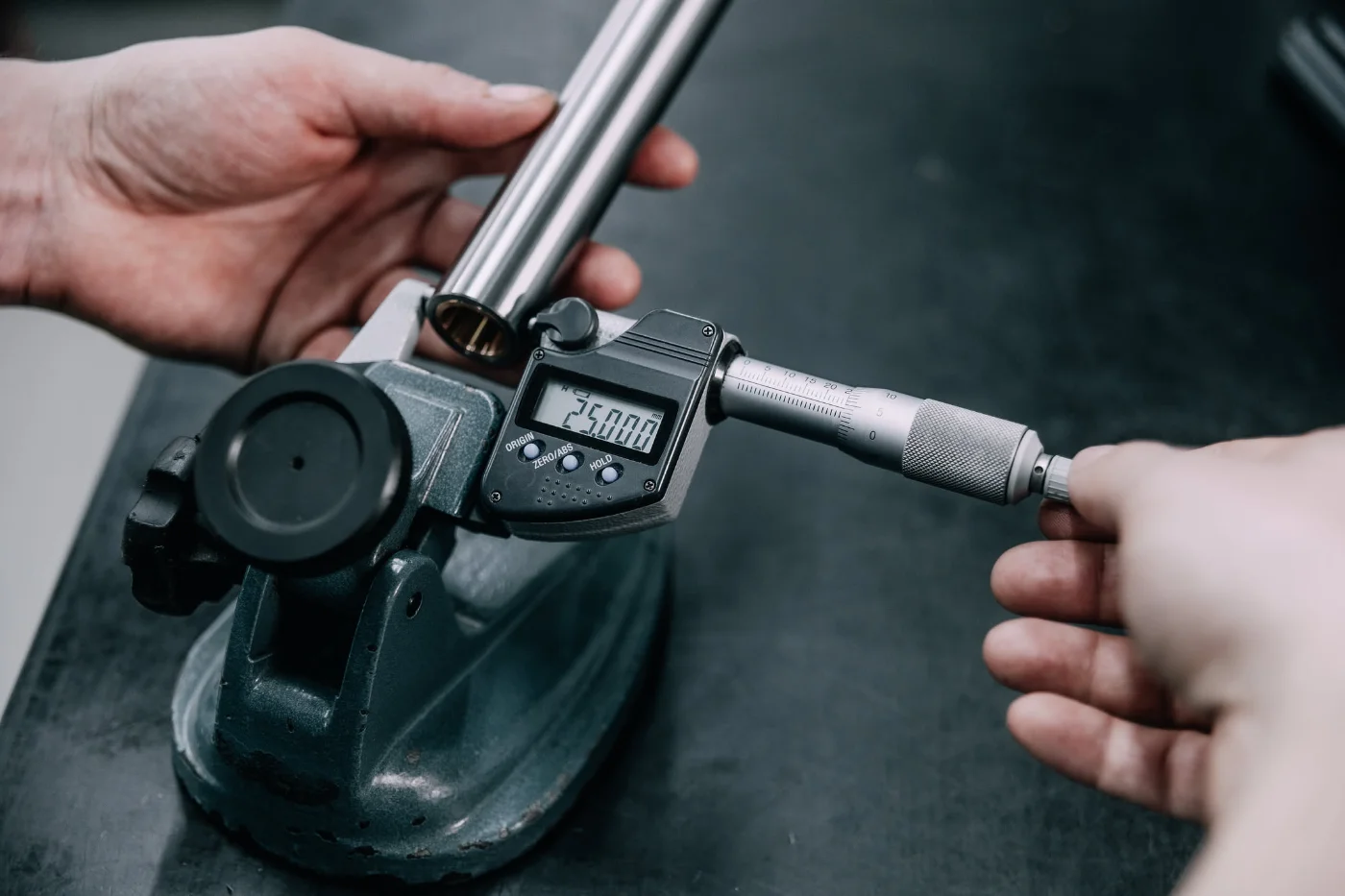
Quality control includes hardness testing to PN-EN ISO standards, usually Rockwell or Vickers. For higher requirements, microstructure examination assesses changes in the material during heat treatment, along with non-destructive testing. Modern furnaces record process parameters, so temperatures and times can be traced for every batch – important in series production and consistent quality control.
What to specify when ordering hardening and tempering
To let the hardening shop select hardening and tempering parameters, provide:
- the material grade with certificate,
- the technical drawing and quantity,
- required hardness with tolerance,
- information on previous heat treatment,
- technical requirements for distortion, surface and inspection,
- operating conditions of the part, if relevant.
This makes it possible to match the type and temperature of tempering to the required properties.
Hardening and tempering at Sacher CNC
Sacher CNC has its own hardening shop with vacuum furnaces, where we carry out hardening and tempering, carburizing and plasma nitriding. Machining, heat treatment and grinding are done in one plant, which shortens lead times and simplifies quality control for medium and large series. More on the Heat Treatment page and in the article What Is Vacuum Hardening?.
Send us your drawing for a quote – specify the material grade, required hardness and quantity.
Steel tempering – FAQ
What does tempering involve?
Tempering involves heating hardened steel to a temperature below the hardening temperature, holding it and cooling it. The process relieves stresses and reduces brittleness. Tempering always follows hardening.
At what temperature is steel tempered?
Usually 150–650°C: low tempering 150–250°C, medium 250–500°C, high 500–650°C. The exact temperature depends on the steel grade and required hardness.
How long should steel be tempered?
Holding usually takes at least 1–2 hours per cycle, counted from temperature equalisation through the section. Tool steels are often tempered two or three times.
What are the tempering methods?
Steel tempering methods are low, medium and high tempering, and multiple tempering for tool steels. Tempering is done in air furnaces, protective atmospheres, vacuum, or oil and salt baths.